13 Proven Steps: How to Start a CBSE School in India

How To Start a CBSE School In India

13 Steps: How to Start a CBSE School in India [Proven Guide] | Life Educare
Founder's Field Guide · K-12 in India

13 Proven Steps: How to Start a CBSE School in India

How to start a CBSE school is not a brochure question — it's the version we wish someone had handed us before we registered our own trust, bought land, and sat through our first Inspection Committee visit. This is how it actually goes, step by step.

1.5 acres
min. land, outside city limits
₹1,000–1,400
construction cost / sq ft
~4 months
application to affiliation, under SARAS
Year-round
applications open since 17 Sep 2025
Before we get into land and paperwork: the first rule of how to start a CBSE school in India is that a school cannot be run for profit. Full stop. Whatever you eventually call it — CBSE, ICSE, IB — the entity that owns and runs it has to be a Society, a Trust, or a Section 8 company. Everything else in this guide sits on top of that one fact, so get comfortable with it before you look at a single plot of land.
01 — Land

Step 1: How Much Land You Need to Start a CBSE School in India

This is the query we field the most from anyone researching how to start a CBSE school — especially people looking at metro plots. The honest answer: it depends heavily on where you're building and up to which class. Here's the real breakdown CBSE works from.

6,000 sq m
≈ 1.5 acres
Default, anywhere in India — this is your fallback number if none of the exceptions below apply.
4,000 sq m
≈ 1 acre
Cities crossing 15 lakh population, state capitals, hill states under NITI Aayog, the North East, J&K, and the Ghaziabad–NOIDA–Faridabad–Gurugram–Panchkula–Mohali belt.
4,000 sq m
≈ 1 acre
Union Territories, blanket rule.
2,000 sq m
≈ 0.5 acre
Secondary level only, in Ahmedabad, Bengaluru, Hyderabad, Pune, or hill stations.
3,000 sq m
≈ 0.75 acre
Senior secondary, same city list as above.
1,600 sq m
≈ 0.4 acre
Secondary level in Chennai, Delhi, Kolkata, Mumbai, Arunachal Pradesh, Sikkim, or the Islands — the tightest tier CBSE allows.
2,400 sq m
≈ 0.6 acre
Senior secondary, same metro list.
12 : 2,000
Every additional 2,000 sq m of land buys you roughly 12 more sections you're permitted to run. Anyone serious about how to start a CBSE school should plan the land purchase around a five-year section count, not just today's intake.

One non-negotiable regardless of size: the plot has to be one contiguous piece, with a pucca boundary wall at least 6 feet high on every side. If it's leased rather than owned, the lease has to run at least 15 years, registered in the name of your society or trust — not any individual.

02 — Construction

Step 2: Building in Phases, Not All at Once

One thing every construction guide on how to start a CBSE school gets wrong: for a budget school built around a 1,000-student intake, almost nobody constructs the whole campus upfront. It goes in three phases, timed to enrolment growth.

Year 1
Phase 1
20,000 – 25,000 sq ft
Year 3
Phase 2
12,000 – 15,000 sq ft
Year 4
Phase 3
6,000 – 10,000 sq ft
Multiply total square footage by ₹1,000–1,400 per sq ft for a realistic construction-plus-furniture number. Marketing, landscaping, and sports infrastructure sit outside this — how much you spend there is entirely a function of the promoter's vision for the school.
03 — Infrastructure

Step 3: The Infrastructure a CBSE School Actually Needs

This list comes from actually building one, not from a checklist you'll find in a generic "how to start a CBSE school" article. Items marked mandatory are the ones CBSE will not compromise on; the rest is what separates a functional school from a good one.

Learning spaces

  • Classrooms — 500 sq ft per 40 students must
  • Library, min. 1,160 sq ft must
  • Computer lab must
  • Maths lab must
  • Composite science lab must
  • Separate Biology, Physics, Chemistry labs
  • Robotics lab
  • Music / dance / art / craft studio

Welfare & access

  • Student & staff toilets must
  • Toilets for children with special needs must
  • Infirmary
  • Counsellor's room
  • Lift hatch or ramp on stairways
  • Cafeteria

Admin & operations

  • Reception, accounts, admissions counsellor
  • Principal & Vice-Principal offices
  • HOD cabins, staff room
  • Exam cell, server room, CCTV room
  • Security post, parking, staff quarters
  • Auditorium, sports room, storage
Education is a state subject in India. No matter which national board you eventually chase, your state board's No Objection / recognition is the gate everything else walks through — anyone serious about how to start a CBSE school has to clear state recognition before CBSE affiliation even opens.
04 — Brand

Step 4: Franchise, or Build Your Own CBSE School?

Not everyone learning how to start a CBSE school wants to build the brand from zero. There's a real market of school brands willing to license their name and systems to a new campus — worth knowing the shape of the deal before you talk to any of them.

DPS Bhartiya Vidya Bhavan Everonn Manipal Shamrock Mayo College Kangaroo Kids
Deposit
Fixed term
Licence fee
Annual
Revenue share
Per student

None of this is standardised — every brand structures it differently. What you're really buying is a head start on curriculum and process, not a guaranteed intake — worth weighing against the DIY route through how to start a CBSE school independently.

05 — The Real Sequence

Step 5: The Legal Foundation of How to Start a CBSE School in India

Three things to get right before anything else — get these wrong and every later step in how to start a CBSE school gets harder.

Form the trust, society, or Section 8 company

Every state runs a Registrar's office for society registration. This entity — not you personally — will hold the land, run the bank accounts, and eventually apply for affiliation.

Not-for-profit onlyState Registrar office

Register or lease the land — in the society's name

Owned or leased, the title needs to sit with the trust, certified by the local land registration office. Leases need a 15-year minimum term. Acceptable ownership documents: Sale Deed, Conveyance Deed, Gift Deed, Lease Deed, Sub-lease, or Allotment Letter, duly registered.

15-yr min. leaseOne contiguous plot6-ft boundary wall

Get state board recognition first

Once the building and staff are in place, you open admissions and simultaneously approach the District Education Office (DEO) with the registration fee. After inspection, they issue the certification your school needs before it can legally take off — and before CBSE will even consider you. Courts have upheld this: state permission is required even for schools ultimately going CBSE or ICSE.

06 — CBSE Affiliation

Step 6: Choosing the Right CBSE Affiliation Category

This is the step most guides on how to start a CBSE school skip. A first-time applicant has five doors to walk through. Picking the wrong one costs you time and staffing money you didn't need to spend yet.

01

Middle school approval

Covers up to the middle years only — the lightest entry point.

Usually the right call02

Fresh affiliation to Secondary (X)

Locks in affiliation through Class X. Re-apply for Senior Secondary a year later, once you've proven demand.

03

Fresh affiliation to Sr. Secondary (XII)

Full run to Class XII from day one — needs every lab and every PGT teacher on staff immediately.

04

Switch-over, Secondary

For schools already running a state board up to Class X wanting to convert.

05

Switch-over, Sr. Secondary

Same, but converting an existing Class XII state-board school.

Why Option 2 usually wins: Senior Secondary affiliation demands PGT-level teachers and full lab infrastructure across every class up to XII from the outset — expensive to staff for a school that hasn't proven local demand yet. Securing Secondary affiliation first, then stepping up, is how most schools actually grow.

Applications are open year-round now

Since 17 September 2025, CBSE no longer restricts the affiliation window to fixed dates — if you're mid-way through how to start a CBSE school, you can apply whenever your paperwork is genuinely ready, rather than racing a seasonal deadline.

07 — Since March 2021

Step 7: SARAS — the Portal Behind How to Start a CBSE School in India

CBSE re-engineered the entire affiliation workflow into SARAS (School Affiliation Re-Engineered Automation System) — it's the actual system anyone researching how to start a CBSE school today applies through. If you're picturing the old paper-heavy process, forget it — this is what changed.

4-month timeline

End to end, application to affiliation, instead of the old open-ended wait.

Auto-approvals

Data-analytics-driven sign-off for extension, upgradation, or section increases.

ML-assisted review

Machine learning reads and cross-checks submitted documents.

Self-certification

Leans on self-certification and public disclosure rather than layers of manual sign-off.

Virtual inspection

A formal provision for remote/virtual inspection, alongside physical visits.

Instant updates

Applicants get real-time status instead of waiting on postal or email updates.

08 — Before You Open the Form

Step 8: The Six Documents You Need to Start a CBSE School in India

Plus a Digital Signature Certificate for whoever will authorise the final submission — Chairman, Trustee, Director, or an authorised representative. Get these ready before you touch the SARAS form; they're non-negotiable for how to start a CBSE school the right way. Then, these six:

01

No Objection Certificate

Issued by the State Education Department confirming no objection to CBSE affiliation.

02

School Recognition Certificate

From the state education department, under the RTE Act 2009 — your state-level affiliation certificate.

03

Land Certificate

Per Appendix X of the Bye-Laws, issued by a DM/ADM/SDM/Tehsildar/Registrar or equivalent authority.

04

Fire Safety Certificate

From the state Fire Department or equivalent municipal authority — must be valid on the date of submission.

05

Building Safety Certificate

From a government-empanelled engineer or authority (PWD, Development Authority, etc.).

06

Society/Trust Registration Certificate

Confirming the legal entity that will run the school.

The NOC rule changed again in February 2025

If you apply without an NOC, CBSE now writes directly to your State Government for comments — and silence is treated as consent, on a fixed clock:

Day 0
CBSE writes to the State Govt.
30 days
Window for the state to respond
+15 days
Reminder sent if silent
No reply
Deemed "no objection"

Beyond these six, keep your school website affiliation-ready (curriculum, TC sample, fee norms, teacher training records, self-affidavit), your UDISE code, audited balance sheets, geo-tagged photos and video clips, and a transport safety certificate on hand — SARAS will ask for all of it in Part B.

09 — Filing

Step 9: Filling Out the Online CBSE Application

The paperwork side of how to start a CBSE school comes down to a fixed sequence on the SARAS portal — here's the exact flow.

KYC form
Part-payment ₹10,000
Part A — core details
Self-cert / DEO cert
Part B — 6 docs + details
Final payment

After Part A, you choose between a system-generated self-certification (digitally signed by the school) or a DEO certificate (signed by the District Education Officer or equivalent). Your registration stays valid only until that session's application deadline — miss Part B by then, and the registration lapses, fee forfeited.

10 — The Physical Visit

Step 10: The Inspection Committee

This is the part people underestimate when they map out how to start a CBSE school. Two things happen on a clock, and missing that clock has a real cost.

15 daysCommittee constituted after your online submission
22 daysPhysical inspection must happen after that
3 datesoffered — coordinate fast, don't waste the window
Typically the panel includes a Kendriya Vidyalaya Principal plus an experienced hand from an aided or unaided school, and the visit runs 5–6 hours — plan for a meal on or near campus. If your school is ready but fails to schedule across all three offered dates without genuine cause, it's a ₹25,000 penalty plus a fresh schedule; fail three times and the application is rejected outright.

What the videographer actually needs to capture

CBSE prescribes the shot list and the time budget for inspection-day videography — worth briefing your camera person on this in advance rather than improvising.

Gate, boundary, parking
≤ 20 min
Playground
≤ 10 min
All labs
≤ 10 min each
Library
≤ 10 min
Toilets (boys/girls)
≤ 10 min each
Drinking water point
≤ 5 min
Fire safety kit
≤ 10 min
Classrooms, occupied & vacant
≤ 20 min / level
Document verification
≤ 1 hour
Faculty interaction
10–15 min
IC report filing
≤ 2 hours

Once the report is filed, CBSE grants affiliation within 30 days. If the committee flags deficiencies, you get 15 days to respond before the clock resets.

11 — Paper Trail

Step 11: Building the Physical Affiliation File

Beyond the online submission, keep a well-tabbed physical file ready for the visit — this is the unglamorous part of how to start a CBSE school that nobody warns you about. Group it like this and nobody's scrambling on inspection day.

Society & governance

7 items+
  • Society bye-laws & constitution
  • Registration certificate
  • School Management Committee list
  • Audited income & expenditure statement
  • Balance sheets, last 2–3 years
  • Bank certificate (relevant if you've taken a project loan)
  • Reserve fund draft, as prescribed in the bye-laws

Staff records

6 items+
  • Staff particulars & service agreements
  • Principal's professional resume
  • Salary statements — paid via ECS, not cash
  • Bank letter re: salary remittance
  • A/C payee cheque copy for salary
  • Teacher training module records

Land & infrastructure

8 items+
  • Land records & certificate
  • Tehsildar/Patwari support docs, if outside municipal limits
  • Approved map & building layout from Town Planning
  • Room-by-room particulars with sizes
  • Building & facility photographs
  • Lab and library facility details, librarian's CV
  • Physical health & recreation facility details
  • Building safety certificate

State & student records

9 items+
  • State board affiliation certificate & NOC (or intimation)
  • Student internal assessment records, class-wise
  • Fee structure
  • School timetable & prospectus
  • Fire safety & sanitary certificates
  • Medical check-up provisions
  • Undertaking — no admissions beyond permitted classes
  • Transport fitness certificate & conveyance details
  • Optional: submitted application copy, bank draft, inspection letter, financial projections
12 — Straight Answers

Step 12: How to Start a CBSE School in India — FAQs

The questions we actually get asked about how to start a CBSE school, answered straight.

?Do I need affiliation before I can start running the school?
No — it's the other way round. The affiliation form asks for real data on enrolled strength and current staff, which only exists once the school is already operating. This trips up almost everyone new to how to start a CBSE school.
?Most of my society is family. Is that a problem?
More than 50% of members being blood relatives is what tips a society into "proprietary" territory, which CBSE disallows. You'll also need to formally declare every blood relationship among members in your non-proprietary affidavit — there's no getting around disclosing it, but a handful of related members is fine as long as they're not the majority.
?I'm running out of a rented building — can I still apply?
The building can be rented, but the underlying land has to be owned or leased to your society, not to a landlord unconnected to it. A common structure: the society leases the land to a company, which builds and then charges the society rent on its own investment.
?Do I have to get state affiliation first, or can I go straight to CBSE?
State board recognition always comes first. CBSE affiliation is only available once that's secured.
?My teacher salaries are below state or central pay norms — is that disqualifying?
Salary benchmarks vary enormously by city and cost of living, and CBSE doesn't police the number itself. What matters is consistency: whatever figure is on the offer letter has to be exactly what lands in the employee's bank account, signed off by them.
?My land documents are pledged with a bank as collateral.
Get a photocopy attested by the bank as a true copy, with the branch manager's signature on it. That substitutes for the originals in your file.
?How long between submission and inspection, realistically?
Budget 3–4 months from submission to the actual visit, and the inspection team itself spends roughly 5–6 hours on campus — arrange for a meal on-site or nearby.
?What's a realistic total investment to open a school?
As a rough planning number for anyone working out how to start a CBSE school: 2 acres of land at prevailing market price, plus construction at roughly ₹1,200 per sq ft. Everything past that — brand, marketing, sports infrastructure — is a choice, not a requirement.
?Can someone get me an affiliation faster through the right contacts?
No. The process is transparent enough that if your paperwork is genuinely in order, you don't need a middleman — and if it isn't, no contact fixes that for you.
13 — Zoom Out

Step 13: The Complete Pathway for How to Start a CBSE School in India

Everything above sits inside a bigger picture. This is the same 10-step framework we run every promoter through when they ask us how to start a CBSE school, from first idea to inauguration day.

Where most projects lose time and money

Almost every costly delay we've seen in how to start a CBSE school projects traces back to skipping Steps 1–3 — feasibility, compliance, and board choice. Get that foundation right first; everything after moves faster. See our full Turnkey Setup service for how we handle all 10 steps end to end.

01
Feasibility Check

Confirm demand, competition, and the numbers before you commit.

02
Strategic Compliance

Trust/society structure, land norms, RTE, state rules — locked in early.

03
Choosing the Board

CBSE, ICSE, IB, or State — pick deliberately; switching later is hard.

04
Project Planning

Timeline, budget, and milestones from ground-breaking to Day 1.

05
Manpower

Right principal, right teachers, right culture — hired early.

06
Brand Positioning

A clear reason parents choose you over the school down the road.

07
Standard Operations

SOPs that keep the school consistent, whoever's on duty.

08
Admission Planning

Outreach, events, digital, referrals — seats filled early.

09
Trainings

Ongoing faculty development to keep standards climbing.

10
Affiliation

Documentation and inspection, handled right and on time.

75+
schools guided, idea to inauguration
10 steps
one pathway, feasibility to affiliation

Still Figuring Out How to Start a CBSE School in India? Let's Talk.

We run Life Educare alongside our own CBSE-affiliated school — if you're weighing land, budgeting construction, or prepping an affiliation file, happy to walk through how to start a CBSE school that actually gets approved. Explore our School Feasibility and Legal Aid services, or browse 56+ schools we've helped launch.
Life Educare · A founder's field guide on how to start a CBSE school, written from experience, not a form letter · For official rules, always cross-check the current CBSE Affiliation Bye-Laws
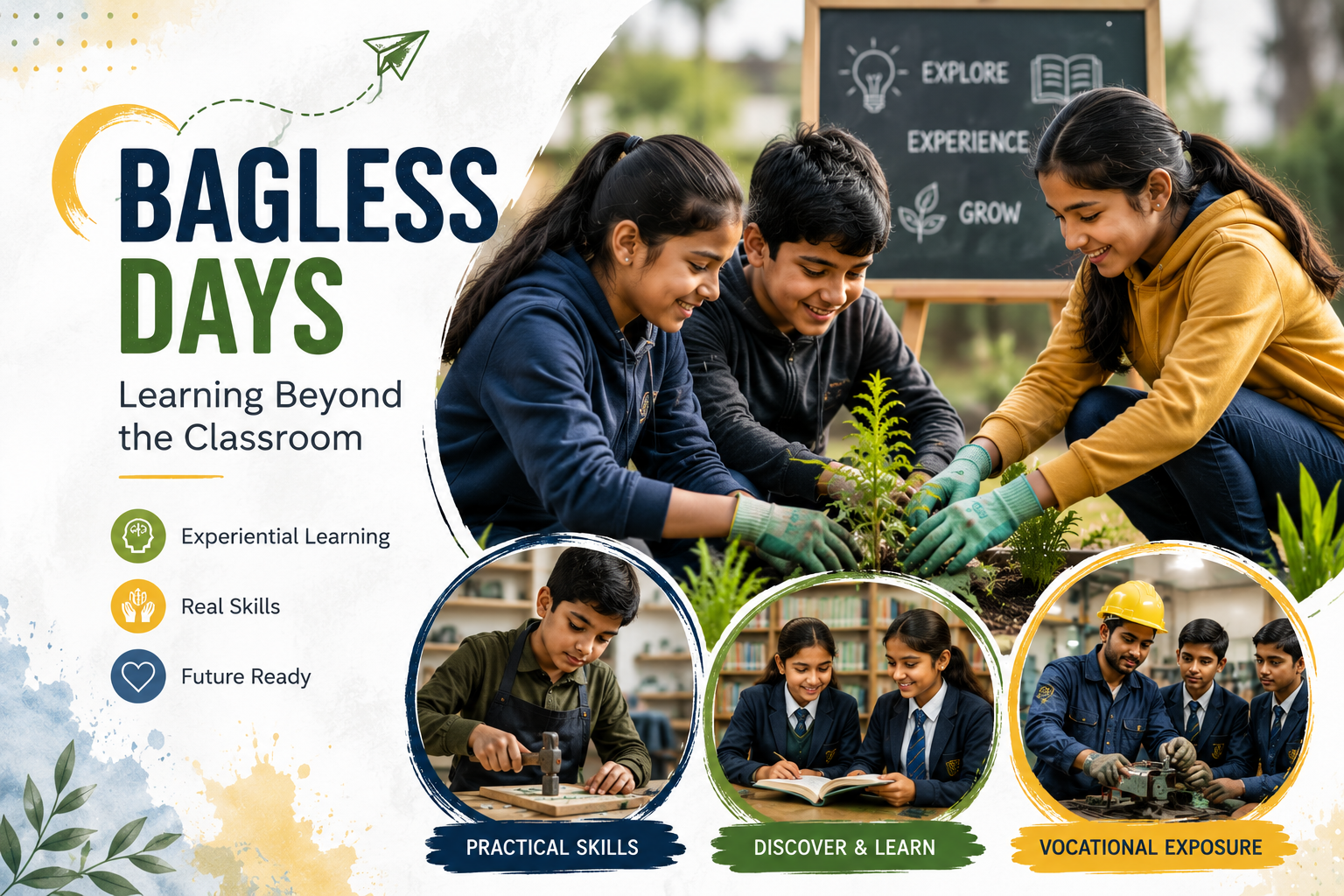
Bagless Days in Schools

Bagless Days in Schools: How NEP 2020 is Transforming Learning Beyond the Classroom

Education is rapidly evolving beyond textbooks, examinations, and rote memorisation. Today, schools are expected to develop practical skills, critical thinking, creativity, and real-world understanding among students. One of the most impactful initiatives introduced under the National Education Policy (NEP) 2020 to achieve this goal is Bagless Days in Schools.

The Bagless Days initiative encourages students to leave their school bags behind and participate in hands-on, experiential learning activities that connect classroom concepts with real-life experiences. Designed primarily for students in Grades 6–8, the programme promotes skill development, vocational exposure, creativity, and holistic learning.

By shifting the focus from memorisation to meaningful engagement, Bagless Days in Schools are helping create confident, curious, and future-ready learners.

What Are Bagless Days in Schools?

The 10 Bagless Days initiative was introduced under NEP 2020 to provide students with dedicated opportunities for experiential learning.

Instead of attending regular classroom sessions, students participate in practical activities, field visits, workshops, surveys, vocational experiences, and community-based projects that encourage active learning.

The initiative aims to:

  • Promote experiential learning
  • Develop practical and vocational skills
  • Foster creativity and innovation
  • Encourage critical thinking and problem-solving
  • Build stronger connections between education and real life

Rather than learning solely through textbooks, students gain knowledge through observation, participation, and hands-on experiences.

Key Highlights of the Bagless Days Initiative

10 Days Minimum Every Academic Year

As per CBSE and NEP 2020 guidelines:

  • Schools must conduct a minimum of 10 Bagless Days every year.
  • These days should account for approximately 60 hours of experiential learning activities.
  • The programme is primarily designed for students in Grades VI–VIII.

Flexible Implementation

Schools are not required to conduct all 10 days consecutively.

The Bagless Days programme can be:

  • Conducted in multiple phases
  • Distributed throughout the academic year
  • Integrated with school events, projects, and vocational learning activities

This flexibility allows schools to plan meaningful experiences without disrupting academic schedules.

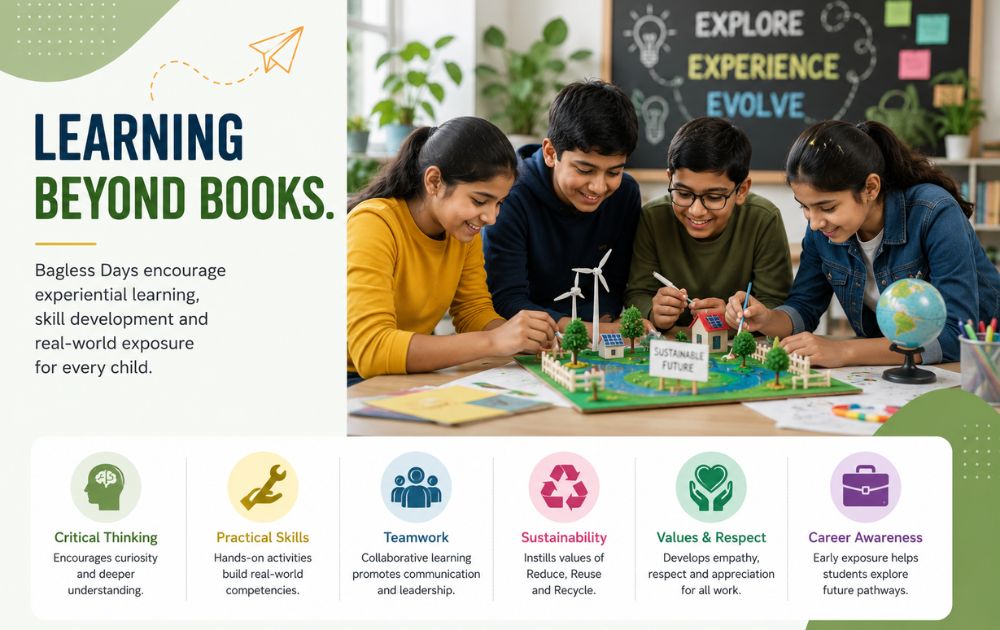
The Triple-H Framework: Head, Hand & Heart

A key principle behind Bagless Days in Schools is the development of the whole child through the Head, Hand, and Heart Framework.

Head

Students develop:

  • Critical thinking
  • Curiosity
  • Observation skills
  • Conceptual understanding

Hand

Students engage in:

  • Practical activities
  • Tool handling
  • Experiments
  • Creative project work

Heart

Students cultivate:

  • Empathy
  • Respect for labour
  • Teamwork
  • Social responsibility
  • Love for learning

This balanced approach ensures learning is intellectual, practical, and emotional.

How Bagless Days Support Vocational Education Under NEP 2020

Bagless Days in Schools

One of the strongest aspects of Bagless Days in Schools is their connection with Vocational Education and the Kaushal Bodh Programme.

These learning experiences allow students to move beyond theoretical understanding and develop practical skills through real-world exposure.

Local Expert Internships

Students can interact and learn from:

  • Carpenters
  • Potters
  • Farmers
  • Gardeners
  • Local artisans
  • Skilled professionals

This helps students understand the value of different professions while learning practical skills.

Institutional Visits

Schools are encouraged to organize visits to:

  • ITIs
  • Polytechnics
  • Skill Development Centres
  • Higher Education Institutions

Such visits expose students to future academic and career pathways.

Career Awareness

Early vocational exposure helps students:

  • Explore different career options
  • Understand workplace environments
  • Develop practical competencies
  • Make informed future decisions

Schools looking to strengthen vocational learning can also explore our guide on Vocational Education for Middle & Secondary Students.

Curriculum Integration: Every Teacher Has a Role

Bagless Days are not limited to activity periods. The initiative encourages all teachers to connect experiential learning with classroom teaching.

Mathematics

Students can learn through:

  • Field measurements
  • Data collection
  • Surveys
  • Practical calculations

Science

Activities may include:

  • Nature walks
  • Experiments
  • Environmental observations
  • Community science projects

Languages

Students can engage in:

  • Interviews
  • Storytelling
  • Local history documentation
  • Reflective writing

Social Science

Students can explore:

  • Community studies
  • Local culture
  • Heritage projects
  • Civic engagement activities

This interdisciplinary approach makes learning more meaningful and relevant.

Core Values Promoted Through Bagless Days

Beyond academic learning, Bagless Days help schools nurture important life values.

Respect for Labour

Students learn to appreciate all forms of work and understand the dignity of labour.

Reduce, Reuse & Recycle

Activities related to sustainability encourage environmental responsibility and awareness.

Lok Vidya and Local Culture

Students gain exposure to:

  • Indigenous knowledge systems
  • Traditional arts and crafts
  • Local languages
  • Community wisdom

Inclusivity

Schools are encouraged to ensure meaningful participation of:

  • Children with Special Needs (CwSN)
  • Students from diverse backgrounds
  • Different learning styles and abilities

Creativity & Teamwork

Collaborative projects promote communication, leadership, and innovation.

Assessment During Bagless Days in Schools

One of the most refreshing aspects of the programme is its approach to evaluation.

No Marks, No Grades

Bagless Days focus on:

  • Learning experiences
  • Participation
  • Reflection
  • Personal growth

instead of traditional examinations.

Feedback-Based Assessment

Teachers provide:

  • Constructive feedback
  • Observations
  • Guidance for improvement

Peer discussions and self-reflection are also encouraged.

Continuous Improvement

School leaders are expected to:

  • Collect stakeholder feedback
  • Review programme effectiveness
  • Improve future implementation strategies

Parents are also encouraged to understand the educational value of experiential learning and support their children throughout the process.

Why Bagless Days Matter for Future-Ready Education

The future demands more than academic knowledge. Students need practical skills, adaptability, creativity, collaboration, and problem-solving abilities.

Bagless Days in Schools help bridge the gap between classroom learning and real-world application by:

  • Encouraging experiential learning
  • Strengthening vocational education
  • Building confidence and independence
  • Promoting creativity and innovation
  • Enhancing career awareness
  • Developing essential life skills

These experiences prepare students not only for examinations but also for life.

Final Thoughts

The purpose of Bagless Days in Schools is not simply to complete a CBSE requirement or fill spaces on an academic calendar. The true objective is to transform learning into a meaningful, engaging, and practical experience.

When implemented effectively, Bagless Days help students develop skills, values, confidence, and curiosity that textbooks alone cannot provide.

Aligned with NEP 2020, this initiative represents a major step toward creating future-ready learners who can think critically, work collaboratively, and contribute positively to society.

At Life Educare, we help schools successfully implement Bagless Days, Vocational Education Programs, Composite Skill Labs, and NEP 2020-aligned learning frameworks that prepare students for the future.

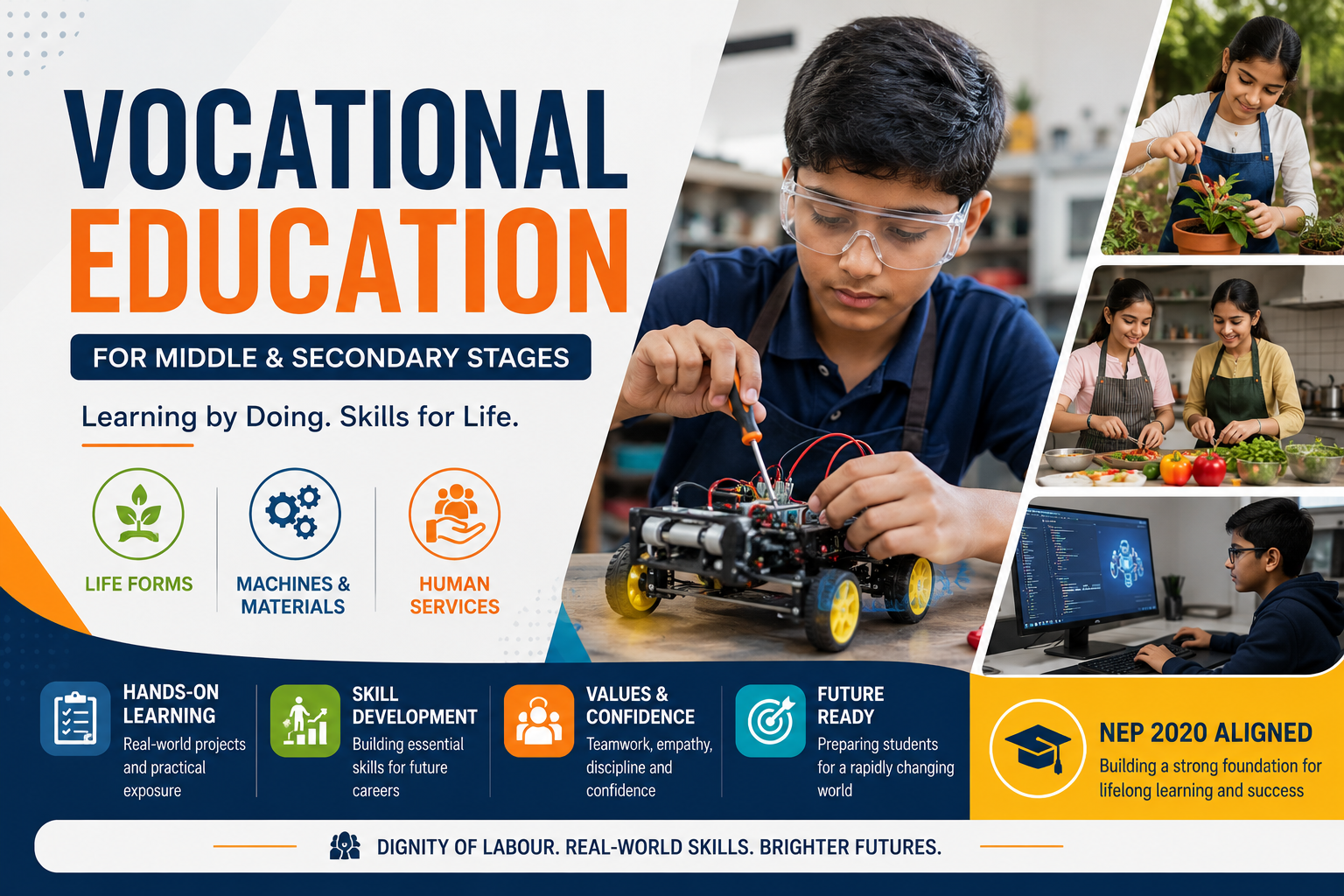
Vocational Education

Vocational Education for Middle & Secondary Students: Building Future-Ready Skills

Education today is no longer limited to textbooks and exams. Students need practical skills, real-world exposure, and hands-on learning to succeed in the modern world. This is where Vocational Education becomes essential.

Aligned with the National Education Policy (NEP) 2020, vocational learning helps students develop creativity, problem-solving abilities, technical understanding, teamwork, and confidence from an early age.

At Life Educare, we believe vocational education is not just an additional subject—it is the foundation for preparing future-ready learners.

What is Vocational Education?

Vocational Education

Vocational Education is a practical learning approach that helps students gain real-life skills through hands-on activities, projects, and workplace-oriented experiences.

Instead of focusing only on theoretical knowledge, vocational learning encourages students to:

  • Learn by doing
  • Explore different career paths
  • Develop practical problem-solving abilities
  • Build confidence and independence
  • Understand real-world applications of education

Under NEP 2020 and CBSE guidelines, vocational education has become an important part of school learning for students from Grades 6 to 10.

Vocational Education Framework for Middle & Secondary Stages

Aspect

Primary Goal

Requirement

Time Allocation

Focus Areas

Middle Stage (Grades 6–8)

Exposure to multiple vocations

9 Projects over 3 years

110 hours annually

Life Forms, Machines & Materials, Human Services

Secondary Stage (Grades 9–10)

Deep engagement with vocational areas

6 Vocational Areas over 2 years

Hands-on practical learning

Advanced procedural and practical skills

Vocational Education in Middle Stage (Grades 6–8)

The middle stage follows a “learning by doing” approach where students actively participate in skill-based activities and projects.

Key Objectives of Vocational Education

1. Develop Practical Skills

Students learn basic technical and procedural skills through activities related to agriculture, electronics, crafts, coding, cooking, and more.

2. Understand the World of Work

Vocational learning helps students understand how different professions and industries function in real life.

3. Build Essential Values

Students develop:

  • Teamwork
  • Curiosity
  • Persistence
  • Empathy
  • Attention to detail
  • Respect for the dignity of labour
4. Apply Skills in Daily Life

The program also encourages students to apply learning at home through practical life-based tasks.

Implementing Kaushal Bodh in Grades 6–8

Want to understand how schools can practically implement vocational learning in middle grades?
Watch our detailed video on “Implementing Kaushal Bodh in Grades 6–8” to explore project-based learning, classroom execution, and NEP-aligned skill education strategies.

👉 Watch the Video Here

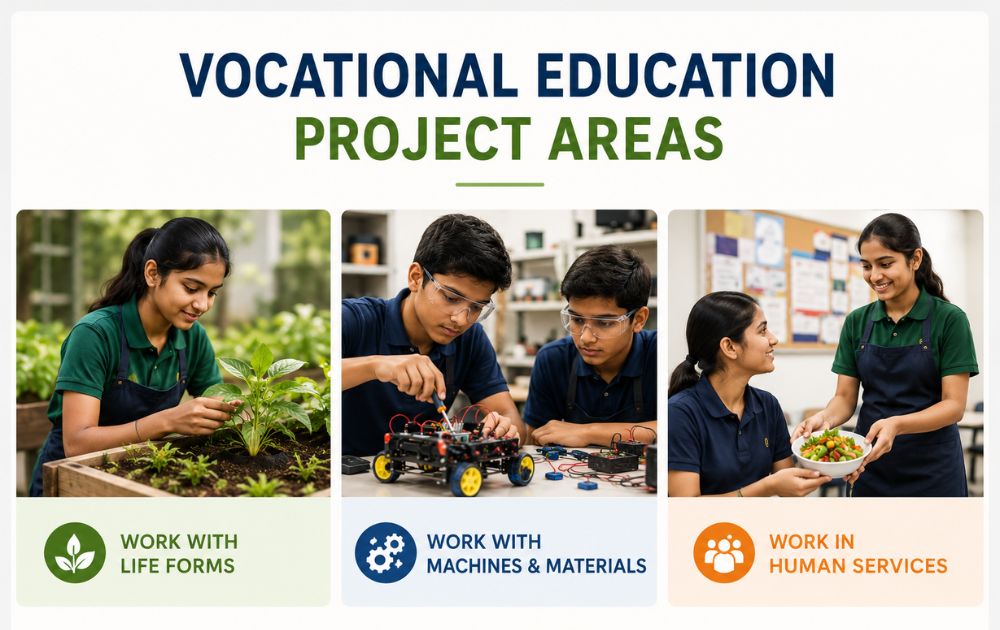
Vocational Education Project Areas

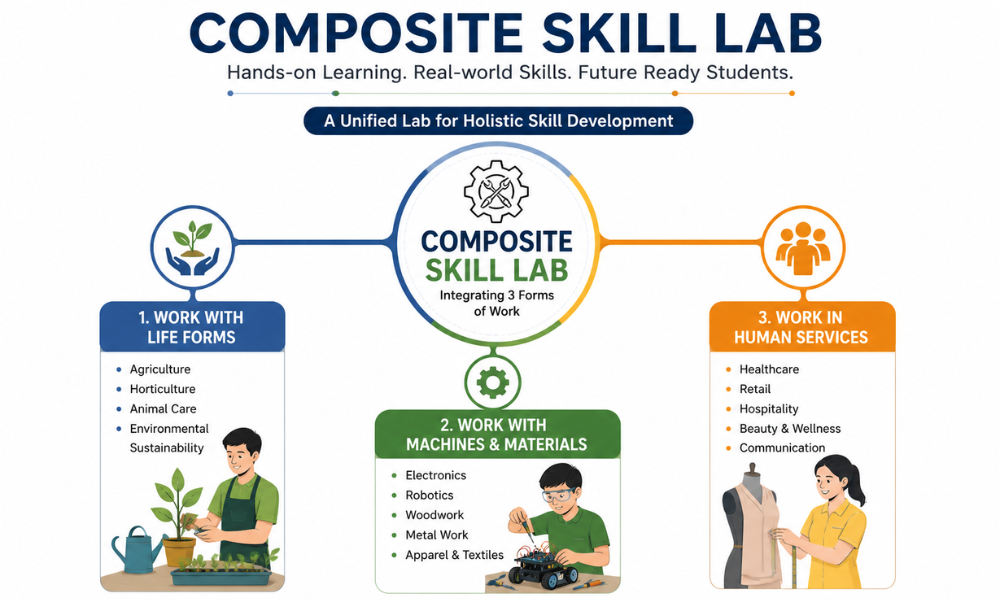
The curriculum is divided into three major forms of work:

1. Work with Life Forms

Activities related to:

  • Agriculture
  • Kitchen gardening
  • Hydroponics
  • Animal care
  • Biodiversity projects
2. Work with Machines & Materials

Skill-based technical learning such as:

  • Electronics
  • Carpentry
  • Robotics
  • Home automation
  • Animation & gaming
  • AI tools
3. Work in Human Services

Projects related to:

  • Healthcare
  • Food preparation
  • Storytelling
  • Community service
  • Advertisement creation
  • Public interaction

Examples of Vocational Education Projects

Grade 6
  • School Kitchen Garden
  • Biodiversity Register
  • Scratch Animation & Games
  • Cooking Without Fire
Grade 7
  • Plant Nursery
  • AI Assistant Projects
  • Tie & Dye Activities
  • Family Health Handbook
Grade 8
  • Hydroponics Systems
  • Home Automation Projects
  • Water Audit Activities
  • Advertisement Creation

These projects help students explore multiple industries and practical skills from an early age.

Assessment Strategy in Vocational Education

Unlike traditional exams, vocational education focuses more on practical performance and participation.

Assessment Weightage

  • 80% Practical Learning
  • 20% Theory

Assessment Includes

  • Activity books and portfolios
  • Viva and presentations
  • Teacher observations
  • Situational problem-solving tests

This approach ensures students learn through experience rather than memorization.

Vocational Education for Secondary Stage (Grades 9–10)

At the secondary level, the focus shifts from basic exposure to deeper vocational understanding.

Students work on:

  • Real-life projects
  • Industry-based learning
  • Product development
  • Technical applications
  • Workplace experiences

The aim is to prepare students for future careers, entrepreneurship, and skill-based opportunities.

Importance of Vocational Education in Modern Schools

1. Improves Career Readiness

Students gain practical exposure to real industries and professions.

2. Encourages Skill Development

Vocational learning builds critical thinking, creativity, and technical abilities.

3. Promotes Experiential Learning

Students learn better when they actively perform tasks rather than only reading concepts.

4. Builds Confidence & Independence

Hands-on learning helps students become self-reliant and confident.

5. Bridges the Gap Between Education & Industry

Vocational education connects classroom learning with real-world applications.

Safety & Inclusion in Vocational Education

Modern vocational education also focuses on:

  • Cyber safety during AI and internet usage
  • Physical safety while using tools and equipment
  • Equal participation for all students
  • Inclusive learning environments
  • Community and industry integration

Schools are encouraged to involve local professionals, artisans, and experts to provide authentic learning experiences.

The Role of Schools in Implementing Vocational Education

To successfully implement vocational learning, schools should focus on:

  • Skill labs and infrastructure
  • Project-based learning
  • Teacher training
  • Industry partnerships
  • Experiential teaching methods
  • Student portfolio development

The introduction of Composite Skill Labs (CSL) is also helping schools create dedicated spaces for practical and vocational learning. Schools looking to implement NEP-aligned skill education can also explore our detailed guide on Composite Skill Lab setup and implementation.

Final Thoughts

The future belongs to students who can think creatively, solve problems, and apply knowledge in real-world situations.

Vocational Education is no longer optional—it is essential for preparing students for future careers and life beyond classrooms.

By combining academic learning with practical skills, schools can create confident, capable, and future-ready learners who are prepared for the rapidly changing world.

At Life Educare, we support schools in building modern education systems that align with NEP 2020, vocational learning frameworks, and future-focused skill development.

Ready to Build a Future-Ready School?

From Vocational Education setup to Composite Skill Labs and complete NEP 2020 implementation — Life Educare helps schools transform into modern, skill-focused learning institutions.

Connect with our experts today and upgrade your school for the future.

Untitled design (2)

Composite Skill Lab: Complete Guide for Schools (NEP 2020 & CBSE CSL Setup)

Composite Skill Lab

The future of education is changing rapidly. Traditional classrooms are no longer enough to prepare students for real world challenges. Today, schools must focus on skill based learning and this is where the Composite Skill Lab plays a crucial role.

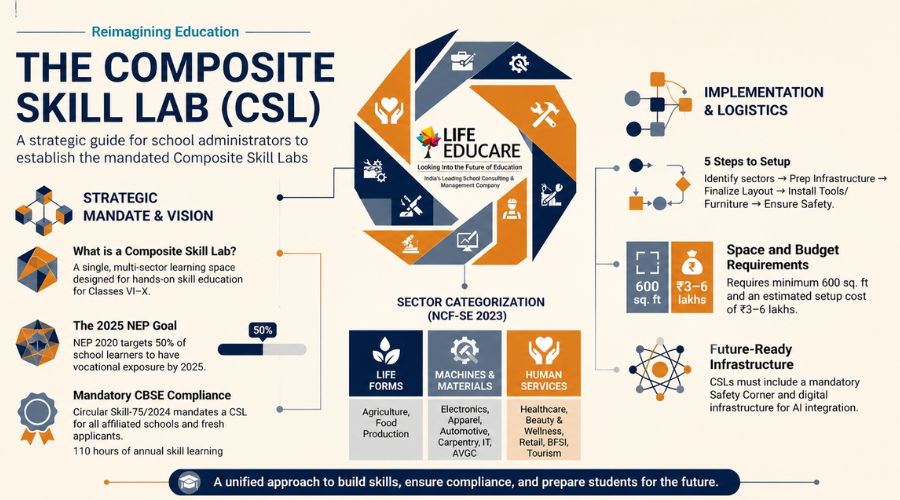
Under the National Education Policy (NEP) 2020, CBSE has made it mandatory for schools to establish a Composite Skill Lab (CSL) to integrate vocational education from Grades VI to X.

This is not just an upgrade it is a transformation from theory based learning to practical, skill driven education.

What is a Composite Skill Lab?

A Composite Skill Lab is a dedicated space in schools designed for hands on, practical learning across multiple vocational subjects.

It allows students to:

  • Work with tools and machines
  • Learn real world skills
  • Apply concepts practically

Unlike traditional classrooms, a Composite Skill Lab focuses on learning by doing.

Why Composite Skill Lab is Important in Schools

The introduction of the Composite Skill Lab bridges the gap between academic knowledge and real-world application.

Key benefits include:

  • Development of practical skills
  • Improved problem solving ability
  • Better career readiness
  • Exposure to multiple vocations
  • Increased student engagement

It ensures that students don’t just learn they apply.

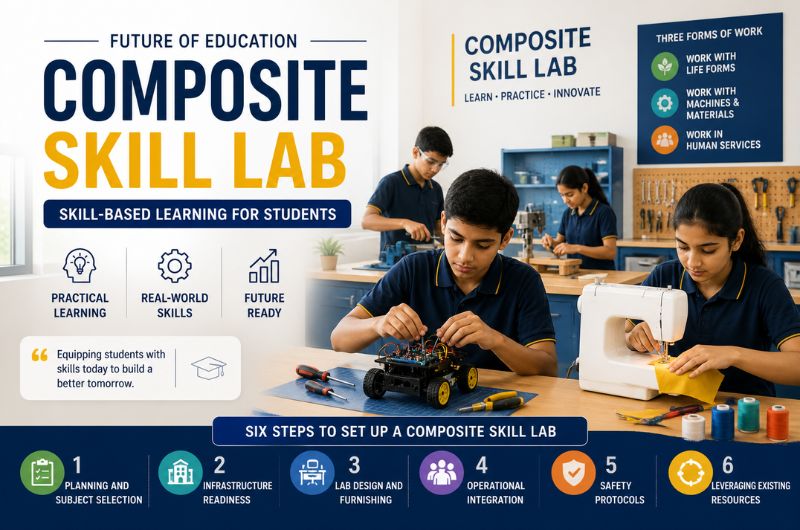
Six-Step Guide to Setting Up a Composite Skill Lab

1. Planning and Subject Selection

To successfully implement a Composite Skill Lab, schools must:

  • Follow CBSE guidelines for CSL setup
  • Select skill subjects based on local needs
  • Cover three key areas:
    • Work with Life Forms (Agriculture)
    • Work with Machines & Materials (Electronics, Apparel)
    • Work in Human Services (Healthcare, Retail)

Students must complete 110 hours of skill education annually, making the Composite Skill Lab a core part of the curriculum.

2. Infrastructure Readiness

A well-equipped Composite Skill Lab requires:

  • Minimum 600 sq. ft. space
  • Proper electrical fittings (5-amp & 15-amp sockets)
  • Ventilation, lighting, and safety flooring
  • Digital setup for AI-based learning

A strong infrastructure ensures effective skill-based education.

3. Lab Design and Furnishing

The design of a Composite Skill Lab should be flexible and practical:

  • Modular workstations
  • Movable benches
  • Organized storage systems
  • Tool display boards
  • Projectors or LED screens

This makes the lab dynamic and adaptable for different activities.

4. Operational Integration

A Composite Skill Lab must be fully integrated into school operations:

  • Include skill education in timetable
  • Implement project-based learning
  • Conduct regular assessments
  • Train teachers for skill-based teaching
  • Build partnerships with industries and experts

Schools can also organize Kaushal Mela (Skill Exhibitions) to showcase student learning.

5. Safety Protocols

Safety is essential in a Composite Skill Lab.

Schools must ensure:

  • Fire extinguishers and first aid kits
  • Safety instructions displayed clearly
  • Proper labeling of tools
  • Emergency drills and training

A safe environment ensures confident learning.

6. Leveraging Existing Resources

Schools can optimize existing infrastructure:

  • Use IT labs for digital skills
  • Utilize Atal Tinkering Labs (ATL)
  • Convert Makerspaces into CSL

However, dedicated compliance is necessary for a proper Composite Skill Lab setup.

How Composite Skill Lab Transforms Education

The Composite Skill Lab is not just about vocational training it is about preparing students for life.

Students gain:

  • Practical exposure
  • Confidence
  • Technical literacy
  • Real world understanding

Conclusion

The Composite Skill Lab is a major step toward future ready education.

By combining academics with practical skills, schools can create confident, capable, and career-ready students.

With NEP 2020 and CBSE guidelines, adopting a Composite Skill Lab is no longer optional it is essential.

Because the future belongs to those who can create, apply, and innovate not just memorize.

Planning to implement a Composite Skill Lab in your school? Our team helps schools with complete setup, compliance, and execution.

Get in touch to get started.

photo_2026-02-09_17-40-51

Start a Trust / Society for School

To start a school in India one has to begin with forming a TRUST/ Society. 

Q.1 Can an individual start a School without forming a Trust/Society?

The existing norms stipulate that educational Institutions must be run as service to the community. Accordingly, the opening of new schools in the private sector and subsequent affiliation with State Education Board / CBSE /CISCE, is permissible only if they are established by a registered Welfare / Charities / Educational Trust or Society. Therefore, any individual / organization / association / society willing to open a new school, requiring recognition of the State Government and affiliation with any State / Central Board will have to constitute a Non-Proprietary Trust / Society, duly registered under Indian Trust Act-1882 or Society Registration Act – 1860. Now CBSE also permits Companies registered under Sec 8 (Section 25 companies are called as Section 8 companies as per the Companies’ Act 2013) to establish schools. Details are available with

Q.2 What is the procedure for constitution & registration of Trust /Society?

Some of the salient points for constitution / registration of the Trust / Society are given below: –

  1. a) Finalize the name of Trust / Society and fix the official location for operation of the Trust / Society.
  2. b) Finalize the name of the chairman & another minimum of two members of the Trust or seven in case of Society. The members of the Trust should not be blood-related to each other to ensure proprietary character of the Trust.
  3. c) Obtain the electricity connection and landline telephone connection and open a bank account in the name of the Trust / Society.
  4. d) Submit the relevant official documents for registration of the Trust / Society to the Assistant / Deputy Charities Commissioner of the area / district, where the office of the Trust / Society is located.
  5. e) If required, seek local assistance from any legal / non-legal person experienced in registration of the Trust / Society.
  6. f) Apply for Income Tax exemptions under various sections, including 80 G and 12 A.

Q.3 How many minimum members are required to form a Trust/Society?

A Trust can be formed and registered with a minimum of 03 members and a maximum of 21 members. In case of Society, minimum of 7 members are required.

Q.4 What is the kind of Trust/Society required for a school project? What are the conditions put by CBSE / ICSE to form a trust?

Any Religious / Welfare / Educational Trust or Society can set-up Institutions for school / professional / medical / engineering education for service to the society, provided this aim has been mentioned in the Trust Deed or Society bye-laws. The Trust should be of a Non- proprietary character so that it does not vest control in a single individual or members of a family.

Q.5 Is it necessary to form a Trust/Society?

Yes, it is absolutely necessary to form a Trust for setting up a School. As per CBSE / CISCE bye-laws, the schools administered and managed by a registered Trust / society are only eligible for affiliation with these Boards. Of late, CBSE also permits Companies registered under Sec 8 (Section 25 companies are called as Section 8 companies as per the Companies’ Act 2013) Details are available with LIFE EDUCARE PVT. LTD..

Q.6 What is the purpose of forming a Trust/Society rather than running a school by an individual?

As per the rules in force, no part of the income accrued from the school shall be diverted to any individual in the Trust. The Trust / Society has to ensure that the saving after meeting all recurring expenditure in the school shall be utilized for providing additional facilities / infrastructure in the school. Thus commercialization of education can be avoided, if the schools are managed / administered by the registered Trust / Society.

Q.7 i) Can the members of the same family become members of the Trust?

  1. ii) Can the Blood Relations form a Trust?

The husband, wife, son, daughter singly or jointly can be the members of the Trust provided that they do not vest control of the Trust. In other words, if the husband as well as the wife (2trustees), are the members of the Trust, then the Trust should have another 3 to 4 trustees who are not members of the same family, to prevent the husband-wife team vesting the control of the trust. Thus the total membership of the Trust in this case will have to be enlarged to 5 or 6 Trustees, out of which 3 to 4 Trustees should not be from the same family. Likewise, in case a trust is constituted with husband, wife and son / daughter (three trustees), then the Trust will have to have another 4 to 5 trustees, who are not the members of the same family.

photo_2026-02-09_17-40-49

Managing a CBSE, ICSE, IB School in India

Q.1 Who will finally control the functioning of the school?

The registered Trust / Society constituted under Indian Trust Act 1882 / Societies Registration Act – 1860 with be responsible for the establishment and administration / management of the school as per the objectives set forth in the Trust Deed / Memorandum of Association and bye-laws of the Trust / Society. The Trust / Society will have absolute powers to frame or amend or modify rules and regulations, objectives, policy directives for administration and management of the school, in accordance with the relevant laws of the Trust / society, the organizational set-up of LIFE EDUCARE MANAGED schools will be as follows:

SCHOOL MANAGEMENT_OPTION PARTNERS

Q.2 Will your have experts and celebrities in the field of Sports, Music and Creativity in the Management committee?

As per affiliation bye-laws of CBSE, all schools have to constitute a School Management Committee (SMC) comprising a minimum of 11 members and maximum of 21 members. In the School SMC will, inter alia, comprise 02 Educationists, 01 female educator, 2 parents, two teachers and also eminent personality in the field of art / culture and 01 professional administrator / CA / Doctor / Architect. The chairman of SMC should make all our efforts to approach the eminent personalities in their respective field and have them included in the SMC with their prior and written consent. In addition, any other celebrity in the field of games / sports may also included in the SMC.

Q.3 What will be the various committees which will help the functioning of the school?

  1. As per the organizational set-up, all LIFE EDUCARE MANAGED Schools will function under the overall administrative control of the Trust. The day-to-day functioning of the school will be entrusted to the School Management Committee (SMC) by the Trust. The SMC will manage the school as per the objectives and vision of the Trust and will be assisted by four sub- committees to ensure the efficient functioning of the school. The four sub-committees of the SMC are:I) Finance / Executive CommitteeII) Staff Selection CommitteeIII) Sports / Extra-Curricular Activities CommitteeIV) Co-curricular / Cultural Affairs CommitteeV) Other Academic committees formed by the principal such as examination, events, quiz, science, discipline etc.
  2. All complaints or matters pertaining to the functioning of the school will be brought to the notice of the Principal (Administrative Head) of the school or any of the sub – committees or School Management Committee.

photo_2026-02-09_17-40-47

What is the TIME FRAME for starting a school in India

This post is meant as an idea guide for clients willing to sign with Life Educare

Q.1 If I am signing an agreement today, when can the school be operational?

The most crucial actions required to be undertaken for starting a school are:

  1. a) Formation & Registration of a Trust / Society
  2. b) Acquisition of Land
  3. c) Construction of the School Building

Therefore, time required to make any school to be consulted by Life Educare will entirely depend on the speed with which above jobs are executed by the Trust. If all the actions mentioned above are well coordinated, it should be possible to make a school operational in about 12 Months.

Timelines for School in India Option Partners


Q.2 What will be the time frame to start the school, after signing the agreement?

The Time Frame for completion of three crucial actions essential for starting a school will primarily depend upon the initiative, action orientation and level of involvement of the Trust. However, average time frame for completion of these activities are as given Life Educare managed schools:

Ideally a time period of 45-50 weeks is required to start a school from thought to finish.

Q.3 What are the different pre-requisites required for taking-up the project for the school?

Any individual or a group of individuals willing to start School should undertake the following procedures / formalities:

  1. Be in possession or agreeing to acquire minimum 1.5 Acres land in non-metro and 0.75-Acre land in metro locations. Though, the actual land required may be more.
  2. Should have formed or agreeable to form a Trust / Society under Indian Trust Act-1882 / Bombay Public Trust Act-1950 or Societies Registration Act-1860 or a section 8 company.. The trust should be of non-proprietary character.
  3. Should have proof of adequate financial resources to guarantee commencement of the school project within a reasonable time frame.
  4. Should have passion for service to the society.

Q.4 How can a Trust minimize the time for starting of the school project?

Considering that a normal time frame for starting a full-fledged school is 12 months. The New academic session for all CBSE affiliated schools commences on 01 April every year. Accordingly the project has to be started. In case of delay in commencement, Life Educare Team can help speed up the process by using its Partner Network. For example, the architects we work with can help design the campus with reduced time frame and yet deliver quality.

Q.5 Can a Trust / Society already formed / registered start the school in a temporary hired building?

Legally it’s possible, however the lease should be for minimum 33 years, else CBSE permission will not be granted, however Life Educare does not work on such projects.

photo_2026-02-09_17-40-45

Growth of a School in India

How does a School Grow?

Q.1 How many sections per class does a Life Educare Managed schools need to have to start with ? How will the school grow thereafter?

Depending upon the infrastructure available at Life Educare managed Schools can be started as 1- Section to 4 – Section school. However, it is recommended to start a new Life Educare School as 2 – Section school from standard I to VI. Keeping In view the financial viability of the project, this school will gradually witness vertical growth up to Senior Secondary level (10+2) during the next 5-year period.

Q.2 Can a Trust start the School up to standard II or III or IV?

Any Trust can start the School up to standard II or III or IV. However, Life Educare recommends that all schools should start classes from standard I to VI with 2 sections in each class. The advantages of this practice will be as follows:

  1. a) The schools can apply for affiliation to CBSE for middle class syllabus as soon as the school starts classes for standard VI in the following year.
  2. b) The school will initially start with about 300 children on its rolls. This will generate necessary revenue income to provide financial stability to the school.

Q.3 The School will be up to which class?

Starting with a 2-section school from standard I to VI, Life Educare MANAGED School will witness horizontal as well as vertical growth with addition of 2 sections in the next higher class in the following years till the schools attains the status of secondary school (upto class X). Further, vertical growth to senior secondary school (upto class XII) will depend upon the provisioning of the requisite infrastructure in these schools.

Q.4 What are the future plans of Life Educare MANAGED Schools for collaboration with foreign institutes?

Life Educare aims to enter into a strategic alliance with world class educational institutes & universities for exposing Indian children to the International arena of school education by introducing renowned curriculum comprising International General Certificate of Secondary Education (IGSCE) by Cambridge University and International Baccalaureate (IB) Diploma, Geneva.

Q.5 What are the stages of development of Life Educare MANAGED? Will it grow into a college?

All Life Educare managed Schools will gradually grow from Primary stage (Class I to VI) to Middle School syllabus (I to VIII) and further to secondary stage (Class I to X). The Life Educare managed Schools will finally become senior secondary Schools (Class I to XII), depending upon the availability of infrastructure in the respective school.

photo_2026-02-09_17-40-44

Financing a School Project

How much money does it take to start a school

Q.1 Will Life Educare have a tie-up with Bank / Financial Institutions for financing the project ?
Yes, LIFE Educare would assist in preparing Bankable project report and obtaining bank finance as it has team of professionally qualified team of Chartered Accountants. The detailed business plan prepared by Life Educare, required to be submitted to the Bank for the financing proposal, would be made available to the Trust after signing up of a separate project finance agreement to facilitate the financing of the project, as mutually agreed. However, finance would be available solely on operational merits of the trust/society.

Q.2 How much investment will be required for Life Educare Project?
The Investment plan will vary according to the model of the school the Trust opts for and the location it chooses. Life Educare would prepare a separate Project Financial Statements and present before the Trust / Society. Such figures are as per standard business plan and may vary 10% – 15% depending upon architectural design & building layout plans quality and quantity of infrastructure.

Q.3 How much income will be generated in the school project?
With key drives and the parameters remaining as planned in the financial projections (which excludes cost of land), the school can be expected to have positive cash flow from the end of the third year. Since the capital outlay is spread over a number of years, available surplus thereafter is projected to meet the part of annual capital expenditure in the future years. The actual results may vary depending upon variation in key business parameters viz. school expansion plans, capacity utilization etc. The individual model-wise financial plans are available with Life Educare

Q.4 What ever income accrues in the school, will it be tax-free?
The income generated by the non-proprietary and Charitable Trusts, managing the school, is tax free up to one crores as per prevailing CBDT directives.

Q.5 What would be the cost of the project if we include the land?
The cost of land would vary substantially with location and size of the plot, which could be added to the cost indicated above.

Q.6 What is the time frame to achieve the break-even point?
Under ideal condition, operational expenses are expected to break even in the middle of the second year. These projections are based on the key parameters; level of activity projected and fee structure. Actual performance and resultant achievement will modify these projections to that extent.

photo_2026-02-09_17-40-53

Deciding the Fee structure for a School

How does one arrive at Fee Structure for an upcoming school

Q.1 How will be the fees be determined?

The issue pertaining to school fees structure will be examined critically and reviewed periodically by Life Educare, based on the ground realities. Based on the market study and competitor analysis along with Differential Analysis, a Performa will be forwarded by Life Educare to the Societies / Trusts on annual basis. The fee will then be finalized by the Chairman. Due considerations will be made for the following in determining the fee structure:

  • Demographics of the city
  • Economic factors
  • Rules / Guidelines of the Central / State Government or its Bodies
  • Guidelines or Norms of Affiliating Body, if any
  • Fees charged by other Schools in the same city
  • Cost of Education per student at Life Educare managed School.
  • Social factors leading to scholarships, freeships, etc.
  • Consideration of students from various backgrounds, including consideration for students with track record / contribution in sports, Arts, Music, Dance,
  • NCC, Scouts, NSS, Other such activities / talents
  • Financial Cost of the Project

Q.2 What will be the fee structure at LIFE EDUCARE MANAGED Schools.?

As per the guidelines issued by the CBSE, the fee charged in any school will have to be commensurate with the facilities provided in the school. Keeping in view the proposed state- of-the-art infrastructure and top-of-the-line technology induction in the School, the following type of fees will be charged in these schools.

Sr. No.     Periodicity of Fee/Payment       Type of Payment / Fee

1           One Time Payment                         Admission Fee &  Security Deposit (Refundable)

2           Monthly / Quarterly Fee               Tuition fee, Annual Charges, Amalgamated Fee, Bus/Conveyance Fee

(These heads of fee are allowed as per the Right to Education Act – 2009.)

Q.3 Who will finalize the fee & fee structure to be charged from the students?

The fee structure at various Life Educare managed Schools will be based on the ground realities at the location of the school and promulgated by the Trust after mutual consultation.

Q.4 What is the rate at which the fee would be increased every year?

The Tuition Fee & other fees including Security will be promulgated by the Societies / Trusts in consultation with Life Educare, at the commencement of the academic session and these fees will not be revised during the middle of the academic session. As per the guidelines issued by the CBSE, the parents’ representatives will be consulted before any upward revision in the fee structure, in the beginning of the academic session. However as per RTE Act-2009, schools are not allowed to increase the fee more than 10%.

Q.5 Will the school provide any fee concessions? What category of children will be granted fee concession in the school ?

The Society / Trust may grant fee concessions to certain category of children studying in the schools. This fee concession may be permissible only in respect of monthly Tuition Fee and all other additional fees viz. Activities Fee, Term Fee, computer / science Fee, Admission, Pupil’s Fund & Security Deposit will be payable in full. Some of the forms of concession that a Society / trust may consider are:

(a) No monthly tuition fee will be payable by the parents having ‘single Girl Child’ in the family.

(b) Maximum of two children (Brother or Sister) of the regular teaching or non- teaching staff of the school.

(c) 20% remission in Tuition fee in respect of second child, in case two children (Brother or sister) of the same parents are studying concurrently in the school.

(d) Full or half tuition fee exemption in respect of poor but deserving & meritorious students or budding / outstanding sports person or talented in the field of art / culture, subject to a maximum of 10% of the total strength of students in each class.

Granting of fee concession will be solely at the discretion of the Chairman of the School.