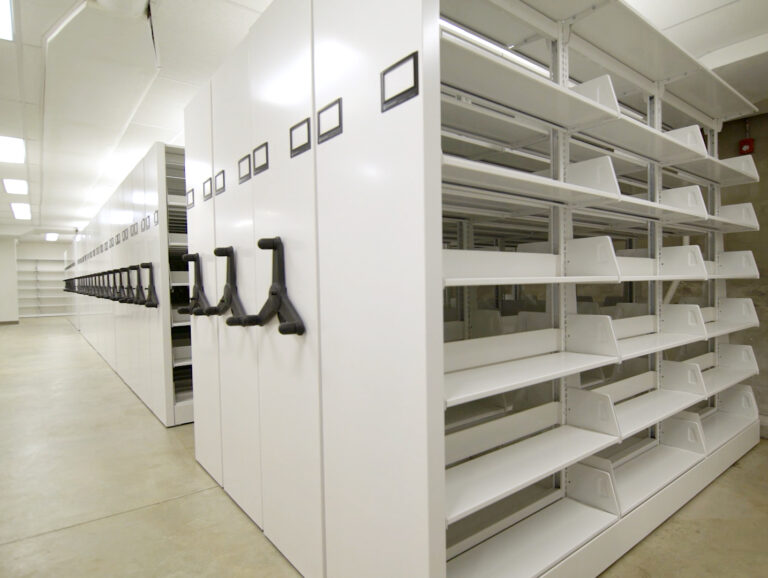
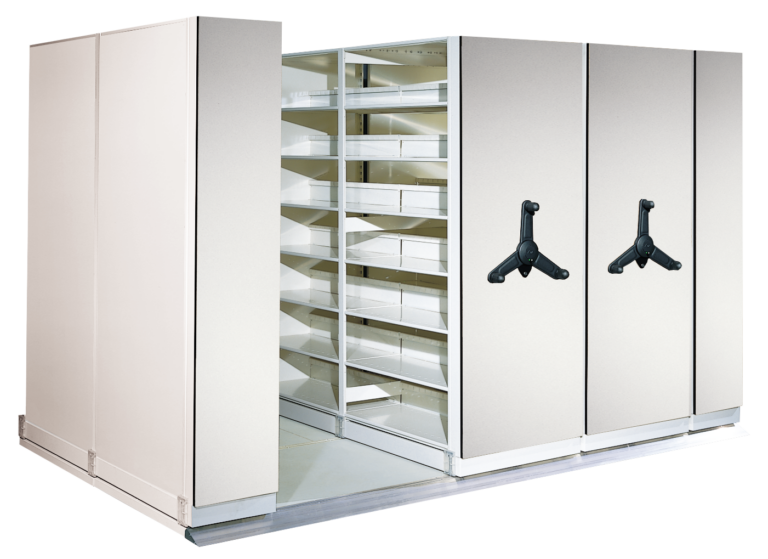
Storage problems are most visible at the point of retrieval. Employees cannot find what they need, supplies migrate into hallways or work areas, and overflow inventory is moved to another room or an off-site location. These issues may appear to be organizational, but they frequently begin with a more basic limitation: conventional shelving devotes too much of the available footprint to aisles.
Mobile storage shelving systems reduce that constraint by placing shelving on carriages that move along tracks. Instead of maintaining a fixed aisle between every row, the system opens an aisle where access is needed at any given time and keeps the remaining rows together. The immediate result is greater storage density, but the operational advantages extend well beyond capacity.
Before: Permanent Aisles Limit Available Capacity
Traditional shelving layouts require enough clearance between every row for people, carts and retrieval equipment. Those aisles are necessary when someone is using them, but most remain empty throughout the day.
As inventory grows, facilities typically respond by adding shelves wherever they will fit. The result may be narrower walkways, overloaded shelving and supplies stored in spaces that were never intended for inventory. Eventually, the organization must expand the storage area, move materials off-site or give up space used for other functions.
After: One Movable Aisle Serves Multiple Rows
Mobile storage shelving systems consolidate rows of shelving so they share a movable access aisle. Employees use manual handles, mechanical-assist controls, or powered controls to open the appropriate section.
By reducing the number of permanent aisles, a facility can use more of the existing footprint for storage. Depending on the project’s goals, that additional capacity can be used in two ways. The organization can store more material in the same room, or it can maintain its current capacity in a smaller area and reclaim the remaining space.
Reclaimed square footage can support workstations, equipment, patient care, public programming or other operational priorities. In this way, mobile shelving addresses both a storage problem and a broader space-planning challenge.
Before: Sensitive Materials Are Difficult to Secure
Security becomes more difficult when materials are stored across several rooms or placed wherever space is available. Files, evidence, pharmaceuticals, museum collections and specialized equipment may require more control than an open storage room can provide.
Adding individual locks to cabinets and shelving can help, but it may create an inconsistent system with multiple keys and access procedures. It also does little to address the security of the room as a whole.
After: Security Can Be Built Into the System
Mobile storage shelving systems can incorporate security at several levels. Depending on the application, the design may include locks for individual cabinets, controls that restrict access to the system or features that prevent unauthorized users from opening particular aisles.
Consolidating sensitive materials can also make access policies easier to manage. Instead of securing several overflow locations, the organization can establish a defined storage area with consistent procedures.
Before: Growth Creates Pressure to Expand
Storage needs rarely remain static. Collections grow, records accumulate, departments add equipment and inventory requirements change. A traditional shelving layout may function adequately at installation but leave little capacity for the next several years.
Without a plan for growth, organizations may find themselves making repeated short-term adjustments. Additional shelving is placed in unsuitable areas, older materials become harder to access and the original organization system gradually breaks down.
Facility expansion can solve the immediate capacity problem, but construction, leasing and relocation may be expensive and disruptive. These options can also provide more space than the organization needs while failing to address the inefficiency of the existing layout.
After: The Storage System Supports Change
Mobile shelving allows facilities to use existing square footage more efficiently before pursuing additional space. Adjustable shelving and modular storage components can also help the system accommodate changes in the inventory itself.
Future needs should be incorporated into the initial design. This includes estimating collection or inventory growth, identifying categories likely to expand and determining whether additional carriages or shelving sections could be added later.
The Operational Advantage Depends on the Design
Mobile storage shelving systems offer clear advantages, but those advantages depend on how well the system reflects daily operations. A layout should account for the number of users, frequency of retrieval, size and weight of stored materials, use of carts or equipment and the number of aisles that must be open at one time.
The goal is not simply to place more items in a room. A successful system should make inventory easier to locate, reduce pressure on surrounding work areas and support the organization as its needs change.
Systems & Space evaluates storage capacity alongside workflow, access and long-term growth. Contact us to schedule a complimentary space analysis and learn how mobile storage shelving systems could improve the use of your existing facility.