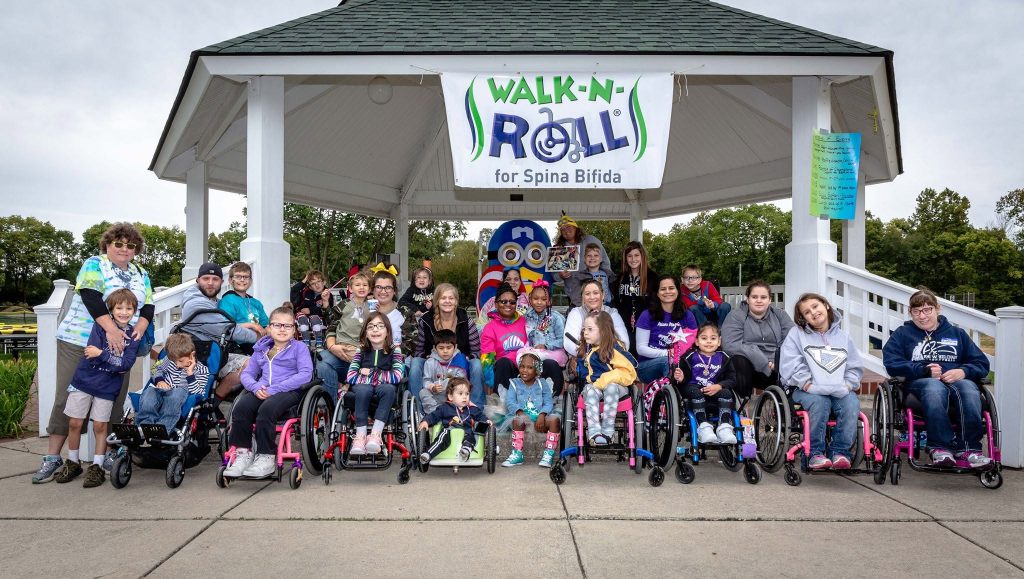
Spina Bifida Indiana (SBIND) is a statewide 501(c)(3) nonprofit, headquartered in Indianapolis, that provides education, advocacy, and support for individuals and families affected by spina bifida. Originally called the Central Indiana Spina Bifida Association, the organization emerged in the mid-1970s, growing from a parent-led support network in Indianapolis into a resource connecting families, medical professionals, and disability advocates across Indiana communities and health care systems. Its development reflects broader changes in pediatric and adult medicine, disability rights, and community support systems in Indiana. The organization adopted its current name in 2014.
Spina bifida is a congenital neural tube defect in which the spinal column does not fully close during early fetal development. Before advances in pediatric neurosurgery and rehabilitation medicine in the mid-twentieth century, infants with severe forms often had limited life expectancy. Improved treatment increased survival, allowing many children to reach adolescence and adulthood and prompting families to seek support for medical care, education, and mobility needs.
SBIND originated in informal meetings among parents of children receiving treatment in Indianapolis, many connected through Riley Hospital for Children. Supported by the hospital’s medical and social-work personnel, families gathered to share information about treatment, assistive devices, and navigating schools and health care services.
These early gatherings developed into a structured organization, established in 1975. Across the 1980s and 1990s, SBIND expanded its role by organizing educational programs, family events, peer support, and familial responses to changes in federal disability policy. Legislation such as the Education for All Handicapped Children Act of 1975 and the Americans with Disabilities Act of 1990 reshaped access to education, transportation, and public accommodations for individuals with disabilities. SBIND provided families with information about these rights and helped them advocate for expanded services.
The expansion of rehabilitation medicine in Indianapolis further influenced the organization’s work. The opening of the Rehabilitation Hospital of Indiana on Indianapolis’s west side in 1988 created new opportunities for adolescents and adults with mobility impairments to receive specialized rehabilitation services. SBIND has supported families navigating the transition from pediatric medical care to adult health services and independent living, including via financial assistance initiatives to defray the costs of long-term care and medical equipment.
SBIND has sponsored programs that encourage social and recreational opportunities for children living with spina bifida. Families have long participated in Camp Riley at Bradford Woods, a medically supported summer camp operated through Riley Hospital for Children and Indiana University. Meanwhile, SBIND community events, such as its annual Roll & Stroll gathering, have brought together constituents and partners while promoting awareness of spina bifida and disability inclusion.
Recent advances in prenatal care are currently reshaping spina bifida treatment as well as SBIND’s activities. Riley Hospital for Children in 2025 began offering in-utero surgery to repair spinal defects before birth and improve outcomes. While not a cure, innovations such as these are changing the trajectory of care, reinforcing SBIND’s role as a resource for families and individuals navigating the evolving landscape of medical and support options.
Wallace, C. (2026). Spina Bifida Indiana. Encyclopedia of Indianapolis. Retrieved Jul 20, 2026, from https://indyencyclopedia.org/spina-bifida-indiana/.
George Anner Shively was a powerful left-handed baseball player who spent most of his career in the Negro Leagues with the Indianapolis ABCs. Standing 5 feet 8 inches and weighing 150 pounds, Shively earned the nickname “Rabbit” for his exceptional speed on the basepaths. He was regarded as a “desperate” baserunner, and his quickness gave him a wide range in the outfield. A solid defensive outfielder and one of the best bunters in Black baseball, he was an extraordinary hitter with moderate power. He was also notably superstitious about his hitting and would not let a right-handed batter use one of his bats.
Born in Lebanon, Kentucky on January 3, 1893, George Anner Shively moved to Bloomington, Indiana, with his father, Joseph, a formerly enslaved individual, before the turn of the century. Shively attended The Colored School during his youth in Bloomington. He began his professional baseball career around 1910, playing in the nearby town of West Baden, Indiana, on C. I. Taylor’s West Baden Sprudels.
Shively followed Taylor when he left West Baden to take over the Indianapolis ABCs in 1914. Oscar Charleston joined the team a year later, and in 1918, when Jimmy Lyons joined the ABCs, the trio was widely acclaimed as the greatest outfield in Black baseball.
As a cornerstone of the Indianapolis ABCs team that won the Western region championship in 1916, Shively established the club as one of the premier franchises in Black baseball. He was selected to the Negro League All-Star team seven times and earned two divisional Most Valuable Player honors, coming in 1914 and 1917. The ABCs barnstormed extensively across the United States, Hawaii, Cuba, and Japan, often facing white major-league players in off-season exhibitions, bringing Indianapolis Black baseball to national and international attention.
Shively left the Indianapolis ABCs in 1919 to play with the Atlantic City Bacharach Giants, but he spent the next several years moving between the East and the Midwest before settling permanently in the East. He began the 1924 season in center field with the Washington Potomacs before being released in early summer and finishing the year with the Bacharachs. Even late in his career he still had enough speed to retain the nickname “Rabbit.” Shively finished his career at the end of the 1924 season. Over his career, he also appeared briefly with Bowser’s ABCs, the Brooklyn Royal Giants, and other clubs.
After his playing career, Shively returned to Bloomington, where he worked as a roofer. He and his wife had no children. He died on June 7, 1962, at Bloomington Hospital at the age of 69 and was buried in Section D, Lot 45, of Rose Hill Cemetery.
For decades, his grave went unmarked and his baseball achievements were largely unrecognized. Interest in Shively was rekindled in 2014, when Bloomington Herald-Times sports editor Bob Hammel brought his story to the attention of noted Negro Leagues historian and author Phil Dixon. In an event at the Monroe County History Center, Dixon spoke about Shively’s career and raised funds to erect a headstone for this local Black athlete. Resulting contributions allowed the installation of limestone headstones for Shively and ten other family members who had been buried near him.
Johnson, S. (2026). George Anner “Rabbit” Shively. Encyclopedia of Indianapolis. Retrieved Jul 20, 2026, from https://indyencyclopedia.org/george-shively/.
Henry Louis “Hank” Aaron was a renowned baseball outfielder and hitter, best known for breaking Babe Ruth’s all-time home run record in 1974. His connection to Indianapolis is brief in calendar time but historically significant: it was the Indianapolis Clowns, the city’s Negro American League franchise, that gave Aaron his first professional contract, his first professional stage, and the audience of major league scouts that launched his subsequent career.
Aaron was born on February 5, 1934, in Mobile, Alabama, the third of Herbert and Estella Aaron’s eight children. He grew up poor in Mobile’s Toulminville neighborhood during the era of Jim Crow segregation, navigating the indignities of a rigidly divided South. A gifted and instinctive athlete, he played sandlot baseball as a boy while gripping the bat cross-handed, a habit he had developed on his own and that coaches would later correct. Aaron briefly played for the semipro Mobile Black Bears before attracting the attention of the Indianapolis Clowns of the Negro American League.
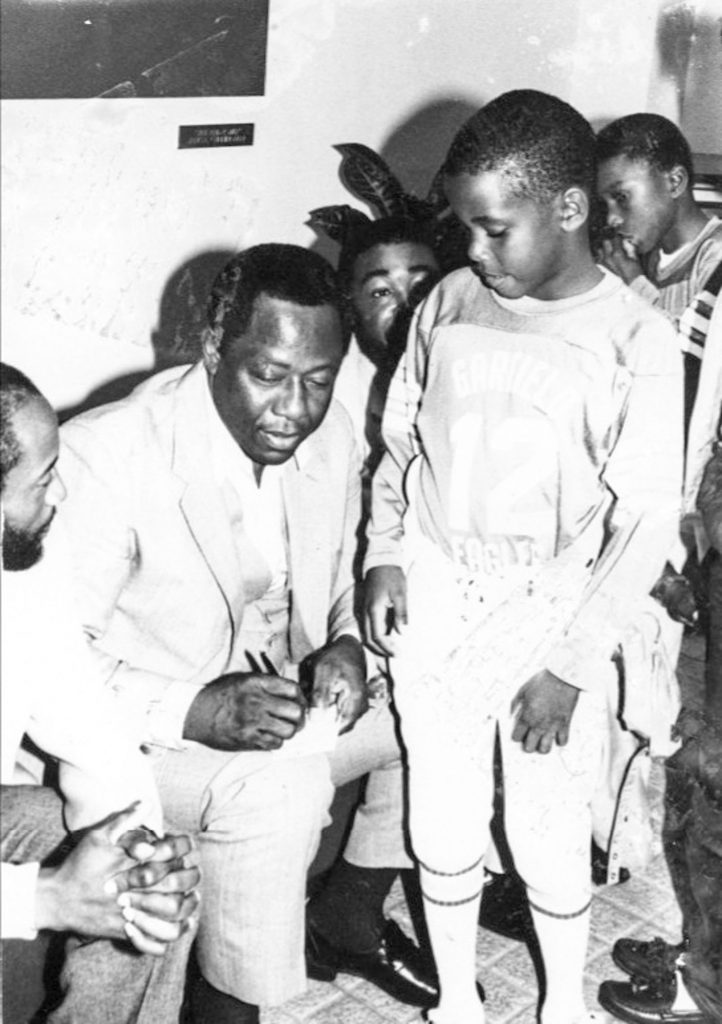
Malik Ali Ahmad gets an autograph from Hank Aaron, 1983 Credit: Indianapolis Recorder Collection, Indiana Historical Society View Source
The Indianapolis Clowns were one of the most distinctive franchises in Black baseball. Founded by promoter Syd Pollock, the team had passed through several identities and home cities, including spells as the Havana Red Sox, Cuban House of David, Miami Ethiopian Clowns, and Cincinnati Clowns, before joining the Negro American League in 1943 and becoming the Indianapolis Clowns in 1946. By the early 1950s, in the wake of Jackie Robinson’s 1947 integration of the formerly all-white major leagues, the National and American Leagues were drawing talent and fans away from the Negro Leagues. Though the Negro American League was weakening rapidly, the Clowns continued to field competitive teams. In 1951, seeking larger crowds and better facilities, the franchise relocated its home venue to Offermann Stadium in Buffalo, New York, while retaining the Indianapolis Clowns name and identity.
Aaron signed with the Clowns in 1952 for a salary of two hundred dollars a month, arranged by the club’s business manager, Bunny Downs, after Aaron had been discovered playing with the Mobile Black Bears in an exhibition game against the Clowns. He began with the Clowns as an eighteen-year-old shortstop and immediately blossomed, helping his team to win the 1952 Negro League World Series championship. Though he only played with the team for three months, in 26 games he achieved a .366 batting average, hit five home runs, and stole nine bases. During this spell, Aaron displayed his range of skills to regional scouts and several major league teams. Both the New York Giants and the Boston Braves scouted Aaron while he was playing with the Indianapolis Clowns. Both teams made offers, but Aaron chose Boston’s offer, which was fifty dollars more per month than the Giants had proposed. In June 1952, the Braves purchased his contract from Pollock for ten thousand dollars, a figure that reflected both their genuine assessment of Aaron’s talent and the still-depressed market for Negro League players, whose contracts cost a fraction of what a comparable white prospect would have commanded. Aaron was assigned to the Braves’ Class C affiliate in Eau Claire, Wisconsin, where he became one of the very few Black players in the Northern League.
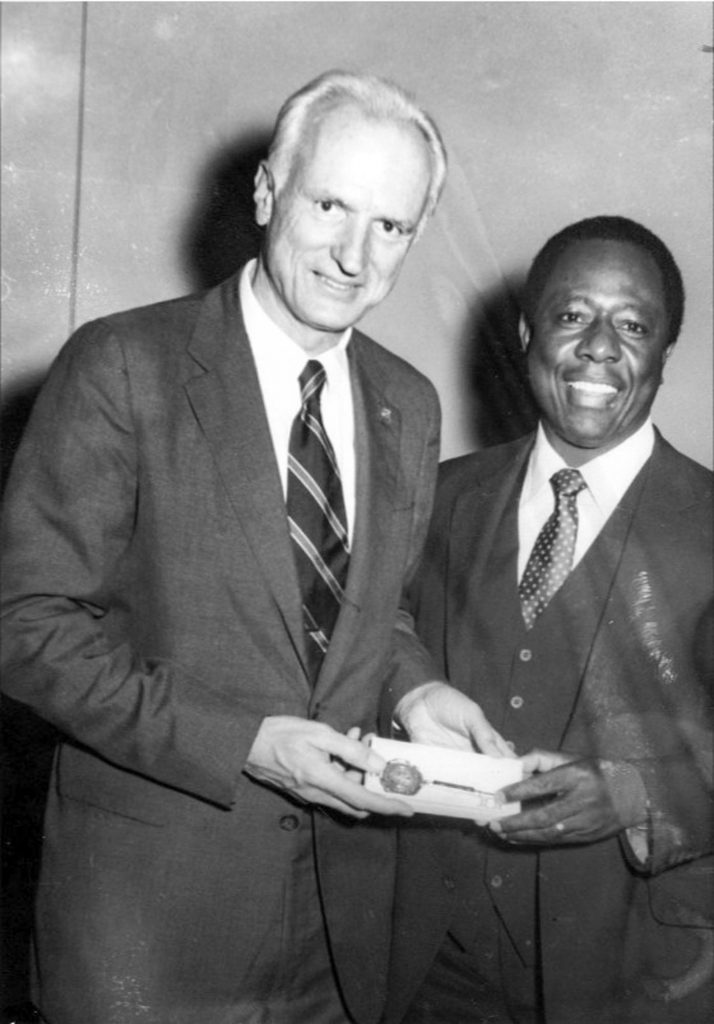
Mayor Hudnut presents a key to the city to Hank Aaron, who was in the city to address the Indianapolis NAACP Life Membership Committee’s annual banquet, 1983 Credit: Indianapolis Recorder Collection, Indiana Historical Society View Source
Aaron went on to spend most of his twenty-three-year career with the Milwaukee and later Atlanta Braves, before retiring in 1976 after two final seasons with the Milwaukee Brewers. He finished with 755 home runs, surpassing Ruth’s record of 714 on April 8, 1974. The weeks leading up to this moment saw Aaron targeted with racist hate mail and death threats. The outpouring required FBI involvement and, as Aaron recalled, scarred him deeply. Aaron was inducted into the Baseball Hall of Fame in 1982. He died of natural causes on January 22, 2021, in Atlanta, Georgia.
Though Aaron’s connection to the Indianapolis Clowns franchise was brief, and came while the club was using Buffalo as its home city, his time with the Clowns contributed to his later accomplishments with the Braves and beyond. Aaron’s Clowns tenure was also significant because it made him the last player with Negro Leagues experience to join a Major League Baseball team.
Johnson, S. (2026). Henry Louis “Hank” Aaron. Encyclopedia of Indianapolis. Retrieved Jul 20, 2026, from https://indyencyclopedia.org/hank-aaron/.
MLA:
Johnson, Spencer. “Henry Louis “Hank” Aaron.” Encyclopedia of Indianapolis, 2026, https://indyencyclopedia.org/hank-aaron/. Accessed 20 Jul 2026.
Chicago:
Johnson, Spencer. “Henry Louis “Hank” Aaron.” Encyclopedia of Indianapolis, 2026. Accessed Jul 20, 2026. https://indyencyclopedia.org/hank-aaron/.
During a career that spanned 30 years, Ben Taylor played for and managed baseball teams in the Negro Leagues and the era before their formal establishment. He primarily played for the Indianapolis ABCs, becoming a premier first baseman, effective clutch hitter, baseball player and later, as a manager, a key mentor for upcoming players. Taylor’s keen mind and analytical approach to baseball enabled him to hit the ball to all corners of the field and defensively protect first base through quick footwork, flexible lateral movement, and a skill for anticipating a hitter’s intentions. His on-field success and managerial skill earned him a posthumous induction into the National Baseball Hall of Fame in 2006.
Benjamin Harrison Taylor was born on July 1, 1888 in Anderson, South Carolina, to Isham Taylor and Adeline Hayne Taylor. Among the couple’s nine children were four baseball-playing brothers who achieved renown in the sport: Ben Taylor (the youngest of the four), famed manager C. I. Taylor, third baseman and manager “Candy” Jim Taylor, and pitcher “Steel Arm” Johnny Taylor. This concentration of talent led sportswriters to dub the Taylors the “first family” of Negro League baseball.
Ben Taylor began his baseball career in 1908 as a pitcher with the Birmingham Giants, managed by his brother C. I. Taylor, before switching to first base, where he would gain a reputation as one of the finest in the game. After two seasons with the St. Louis Giants, he joined his brothers Jim and Johnny Taylor on Owner-Manager Rube Foster’s 1913 Chicago American Giants team.
Taylor joined the Indianapolis ABCs in 1914 when his brother C. I. Taylor managed and owned the team. Playing first base and batting left-handed, he quickly became known as “Old Reliable” for his clutch hitting, smooth fielding, and outstanding defensive play. Furthermore, his scientific approach to hitting enabled him to drill line drives to all fields and execute the hit-and-run play expertly. Taylor was considered the best first baseman in the Negro Leagues before Walter “Buck” Leonard’s arrival in 1933.
Taylor maintained a respectable .308 batting average during the 1915 baseball season, though during the subsequent offseason, playing winter ball in Cuba, Taylor achieved a .500 batting average. The next season, he helped lead the ABCs to a western region championship. During the 1916 Negro Championship Series, he batted .611 with three stolen bases as the ABCs defeated the Chicago American Giants four games to one. Taylor remained with the ABCs through 1918, departed briefly in 1919, then returned from 1920 to 1922. Following the death of his brother C. I. Taylor in 1922, Ben replaced him as manager before leaving Indianapolis in 1923. Taylor founded the Washington Potomacs in 1923, bringing his brother Johnny Taylor along as pitching coach.
Over his playing career, which lasted until 1929, Taylor accumulated 1,250 hits and maintained a .300 or better batting average in sixteen different years. After retiring as a player, he continued as a manager and coach. He served as player-manager for the Washington Potomacs, Baltimore Black Sox, Harrisburg Giants, and Bacharach Giants. In 1933, he managed the Baltimore Stars and tutored a young Walter “Buck” Leonard, a future Negro League star, on approaches to the first-base position. Leonard later said, “I got most of my learning from Ben Taylor. He had been the best first baseman in Negro baseball up until that time, and he was the one who really taught me to play first base.”
At the end of his baseball career, Taylor lived in Baltimore where he owned and operated a poolroom, a shoeshine parlor, and a cleaning and pressing business. He also printed and distributed game programs at Baltimore Elite Giants games. He died of pneumonia in Baltimore on January 24, 1953 and was posthumously inducted into the National Baseball Hall of Fame on February 27, 2006, after Major League Baseball had initiated a process for honoring Negro League standouts who had been excluded from adequate recognition due to racial segregation in baseball during their active careers. Taylor is buried at Arbutus Memorial Park in Arbutus, Maryland. His gravestone reads “A Graceful Player, A Superb Teacher, & A True Gentleman.”
In late 1971, the National Endowment for the Humanities (NEH) collaborated with a group of five Indiana residents—Virginia Ball, Robert Burns, Marvin Hartig, Edward Howard, and Robert Richey—to establish a nonprofit that would help it carry out its work in the Hoosier State. This was part of a broad effort by the NEH to establish a humanities council in every US state and territory. The NEH’s goal was to secure grassroots support for public humanities programs in communities nationwide, with a focus on history, literature, languages, world cultures, philosophy, ethics, and other humanities subjects. By the end of 1972, the founders established the Indiana Committee for the Humanities (later known as the Indiana Humanities Council, today as Indiana Humanities) with its headquarters in Indianapolis.
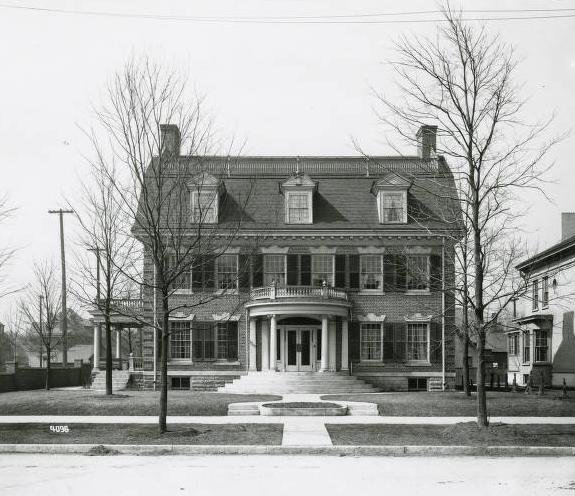
The house of Indiana author Meredith Nicholson has served as the home to Indiana Humanities since the 1980s.Credit: W.H. Bass Photo Company Collection, Indiana Historical Society View Source
Since its founding, Indiana Humanities has facilitated a vast array of programs, including workshops, summits, seminars, and lectures, which have engaged Hoosiers with the humanities and have impacted both the city and the state. In 1983, for example, it convened a group of philanthropic leaders for a series of conversations that led to the establishment of the Indiana Philanthropy Alliance, and in 1991 it formed an International Issues Task Force that laid the groundwork for the opening of the International School of Indiana.
Indiana Humanities’ ongoing mission is to spark curiosity, connect people, and explore the human experience through programs, grants, and storytelling. It sponsors activities across the state that bring people together to engage in the humanities, often organizing its programs in two- to three-year themes, such as Food for Thought (looking at the ways food helps to define Indiana’s culture), INseparable (examining how Hoosiers relate to one another across boundaries), Unearthed (discovering the intersection between the environment and the humanities), and America at 250 (exploring US history, civics, and democracy). Popular activities have included the Campfires series, which connects nature and literature; Chew on This, which brings community members together for an evening of dinner and discussion; INconversation, which engages participants in dialogue with thought leaders; and the Historic Bar Crawl, which presents reenactments of Indiana history along with drinks at Indianapolis establishments.
Participants of the Next Indiana Campfires series read and discuss literature in the natural setting of Eagle Creek Reservoir, ca. 2010sCredit: Keira Amstutz, Indiana Humanities
Indiana Humanities has received the Schwartz Prize, awarded annually by the Federation of State Humanities Councils for the best public humanities program, three times: in 1983 for This Far by Faith: Black Hoosier Heritage; in 2011 for Food for Thought; and in 2017 for Next Indiana Campfires.
Literary programming has been at the core of Indiana Humanities’ work since its founding. One of its longest-running programs is Novel Conversations, a free lending library that sends books to reading groups across the state. In 2019 Indiana Humanities began managing the Eugene and Marilyn Glick Indiana Authors Awards, establishing biannual prizes that honor the best books by Hoosier authors in multiple categories and offering author tours, speaking engagements, and workshops to shine a spotlight on the state’s literary community. To celebrate Indianapolis’s bicentennial, in 2021 Indiana Humanities introduced Bookmark Indy, a literary trail highlighting Indianapolis writers and the role that the city has played in their works. During the 1990s it hosted the popular literary festival Wordstruck, and in 2024 it introduced the annual Proof: A Midwest Lit Fest.
Participants explore the theme of “Latinos and the Next Indiana” at a Chew on This event in February 2016.Credit: Keira Amstutz, Indiana Humanities
In its early years, Indiana Humanities was primarily a grant-making organization, and grants remain a core part of its mission. Each year Indiana Humanities offers a number of funding opportunities to tax-exempt organizations across the state, providing them with financial support to carry out their own humanities programs. Grants fund a wide range of public activities, such as exhibitions, presentations, tours, podcasts, online resources, and more.
Since 1986, Indiana Humanities has operated from the former home of author Meredith Nicholson and his wife Eugenie in Indianapolis’s Old Northside neighborhood. The house, designed by Indianapolis architect Herbert Foltz and completed in 1903, serves as an outstanding example of Georgian Revival architecture. After completing significant renovations to the house in 2018, Indiana Humanities offers its meeting rooms to the public, providing the community with space to connect and converse.
Home Place is a Hamilton County suburban area, centered at the intersection of 106th Street and College Avenue. Before 1914 the area now known as Home Place was called Pleasant Grove, a small farming community of a few homes, a school, two sawmills, and the Pleasant Grove Methodist Episcopal Church. In 1914 the Orin Jessup Land Company purchased farmland in the area and platted Home Place along the Kokomo interurbans line. The company hoped College Avenue would be developed as U.S. 31, but Meridian Street became the federal highway and development moved west of the town. Lot sales slowed and the area never incorporated, although two later additions were platted.
Primarily residential, Home Place counted only about 200 residents in the 1940s when a few small businesses, a general store, and a filling station made up the business district. In the 1970s and 1980s, as Carmel and Indianapolis expanded, a number of subdivisions were built near Home Place. According to estimates, about 5,000 residents lived in the area in 1989. New commercial and residential developments continued to encroach on Home Place in 1990s and little was left of the old community.
Home Place remained the only area in Clay Township that the city of Carmel did not annex. Just a little under two square miles in area, the residents resisted annexation in the courts for decades. In 2016, a state-court special judge cleared the way for Carmel’s legal taking of the area, with or without the approval of Home Place population. The annexation became official on March 1, 2018. It was Carmel’s 57th and completed the township’s complete absorption by the city. In 2021, the city of Carmel began a number of infrastructure improvements for the area, including its first roundabout.
Donnelly, C. F. (2026). Home Place. Encyclopedia of Indianapolis. Retrieved Jul 20, 2026, from https://indyencyclopedia.org/home-place/.
MLA:
Donnelly, Cathleen F. “Home Place.” Encyclopedia of Indianapolis, 2026, https://indyencyclopedia.org/home-place/. Accessed 20 Jul 2026.
Chicago:
Donnelly, Cathleen F. “Home Place.” Encyclopedia of Indianapolis, 2026. Accessed Jul 20, 2026. https://indyencyclopedia.org/home-place/.
Anna Agnew was a writer who achieved recognition for her account of spending seven years as a patient at Indianapolis’s Central State Hospital, undergoing treatment for severe symptoms from what is now known as bipolar disorder. Agnew’s autobiography, From Under the Cloud, provides a unique and detailed account of the details and experiences of daily life for patients living in the asylum.
Agnew (née Keyt) was born in 1836 to Nathan and Martha Keyt of Moscow, Ohio. While she experienced episodic symptoms of bipolar disorder beginning in childhood, later recalling that “even as a child I was always feeling a desire to take my life,” her family misunderstood her symptoms and considered her a “difficult” child. She lived with her parents until her mid-thirties, earning a modest income through her embroidery work.
In 1870, Agnew married David Agnew, a clerical worker, and the pair moved to Cincinnati, Ohio. They moved an additional two times as David pursued various job opportunities—first to Seymour, Indiana, in 1873, and then Vincennes, Indiana, around 1875. Agnew became a homemaker and cared for her three children: Nathan, William, and David.
Evidence suggests that Agnew’s symptoms had abated during these early years of her marriage. Around 1876, Agnew’s mental health began to decline. Because bipolar disorder was not understood at this time, her doctors dismissed her symptoms and misdiagnosed her with hysteria, a popular yet pseudo-medical term used to describe various behaviors that deviated from societal norms. After multiple suicide attempts over the next two years, Agnew’s mental illness worsened even further, causing her to harm one of her children.
During a state of psychosis, she poisoned her youngest son, David, using laudanum, believing she was sparing him from a future of “insanity,” and then disclosed to her husband what she had done. Her son survived the attempt on his life. After this episode, Agnew in September 1878 was institutionalized at the Indiana Hospital for the Insane (later renamed Central State Hospital) as “suicidal and homicidal,” with a diagnosis of “acute mania.”
Agnew remained hospitalized for seven years. When her confinement at Central State Hospital ended in 1885, she and her husband divorced. With nowhere to live, she stayed at the hospital for a short period and earned income by working in the sewing room. By 1886, she was living with her sister Lida in Pittsburgh, Pennsylvania.
In 1886, Agnew published From Under the Cloud; Or, Personal Reminiscences of Insanity. The book details her experiences with mental illness and life in the asylum. At the time of Agnew’s institutionalization, Central State Hospital employed a treatment labeled “Moral Therapy” for patients with mental illness. The treatment replaced abuse and restraint with compassion and kindness. While Moral Therapy was the goal of Central State Hospital physicians, Agnew’s autobiography reveals abuse at the hands of an undertrained and overwhelmed staff tasked with providing care for more than 600 individuals.
Book reviewers expressed shock over Agnew’s revelations about the patients’ treatment at Central State Hospital. Though Agnew noted that “the superintendents were invariably kind,” she went on to say the “attendants were the worst…mostly inexperienced young ladies…heap[ing] all kinds of indignities upon the patients.” She spoke highly of her prescribed treatment by her physicians (Drs. Hester, Evert, Rogers, Thomas, Fletcher, and Stockton), but noted that “the assistant superintendent made my life a perfect hell.” He placed Agnew in a ward for epileptics for one year and told the attendants not to provide her a change of clothing unless she requested it. Upon release, Agnew emerged wearing the same dress, tattered and threadbare from a year’s use. Other indignities included being “dragged by my hair to the dining room” and “beaten.” In her book, Agnew recommended that institutions hire trained nurses and middle-aged women who had experienced mental illness themselves, suggesting that such figures could more compassionately attend to the needs of those in the facilities.
Agnew’s disabling condition remained at bay for about a decade before her symptoms returned. In 1894, she was admitted to the Western Pennsylvania Hospital for the Insane at Dixmount, near Pittsburgh, where she remained until her death on March 25, 1917. By sharing the story of her Indianapolis confinement, Agnew helped illuminate the often overlooked or misunderstood realities of living with mental illness. Her work encouraged readers to advocate for improved conditions and qualified healthcare personnel in the treatment of individuals with mental health conditions.
King, Lucy J. From under the Cloud at Seven Steeples, 1878-1885: The Peculiarly Saddened Life of Anna Agnew at the Indiana Hospital for the Insane. Guild Press/Emmis Pub., 2002. https://search.worldcat.org/title/50170254.
CITE THIS ENTRY
APA:
Fischer, J. E. (2026). Anna Agnew. Encyclopedia of Indianapolis. Retrieved Jul 20, 2026, from https://indyencyclopedia.org/anna-agnew/.
Special Olympics Indiana (SOIN) is a nonprofit organization headquartered in Indianapolis. It provides year-round sports training and athletic competition for individuals with intellectual disabilities. Founded in 1969, the organization emerged shortly after the creation of the global Special Olympics movement. With its launch, Indiana became one of the first states to establish a statewide program of this type.
The origins of SOIN came when educators at Indiana State University in Terre Haute helped to organize the state’s first Olympic-style games. Held on June 6, 1969, the event took place less than a year after the inaugural international Special Olympics. The inaugural games in Terre Haute were well received, leading planners to form a more permanent organization meant to foster year-round sports training and competition for children and adults with intellectual disabilities. These early efforts built on Indiana’s longstanding tradition of robust amateur and community-based sports initiatives.
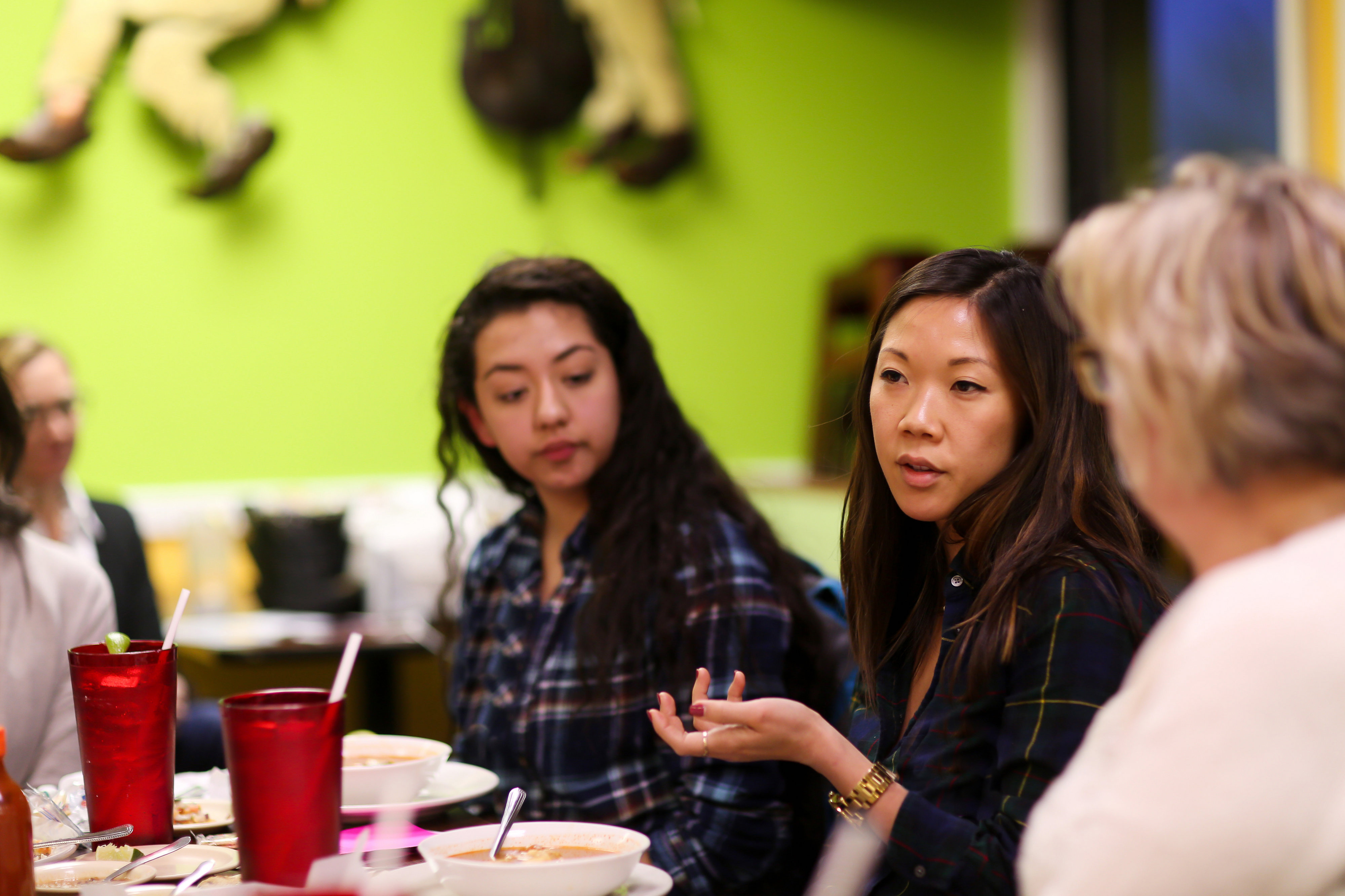
Lawrence Central students at the Special Olympics Indiana Unified Sports Bocce Ball Tournament, 2024 Credit: Special Olympics Indiana View Source
SOIN operates as part of the international Special Olympics network, which was founded in 1968 by Eunice Kennedy Shriver. Like its parent organization, the Indiana program uses sport as a means to promote inclusion, health, and personal development for people with intellectual disabilities. The organization aims to challenge stereotypes about the community it serves through athletic competition and opportunities for participants to develop and demonstrate physical fitness, courage, and local social connections.
Since its founding, SOIN has expanded significantly. One important Initiative in this area includes Unified Sports, where individuals with and without intellectual disabilities compete together, and a series of Unified Champion Schools that foster the program. Access to the Champion Sports program in Indianapolis expanded in 2025, when the Indianapolis Public Schools (IPS) joined SOIN at a Unified Champion School, offering opportunities to IPS students who previously could not compete in SOIN games due to lack of needed equipment, venues, or coaching. Additional programs focus on health screenings, leadership development, youth engagement, community-based fitness opportunities, and school inclusion efforts.
As of 2026, SOIN serves about 20,000 athletes and Unified partners across the state, supported by approximately 10,000 coaches and volunteers. Programming is offered at no cost in more than twenty Olympic-type sports, reaching participants in nearly seventy county programs throughout the state. Athletes compete through a tiered system that includes local, area, and state-level competitions. The annual Summer Games in Terre Haute continue to serve as a centerpiece event.
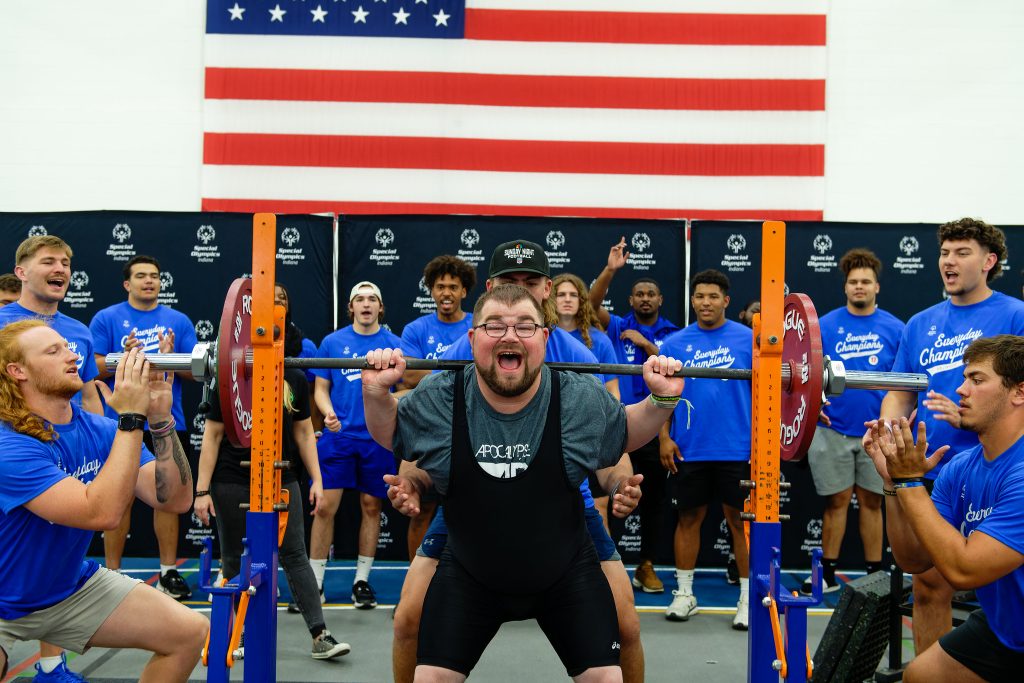
Powerlifter in the Special Olympics Indiana Summer Games, 2023 Credit: Special Olympics Indiana View Source
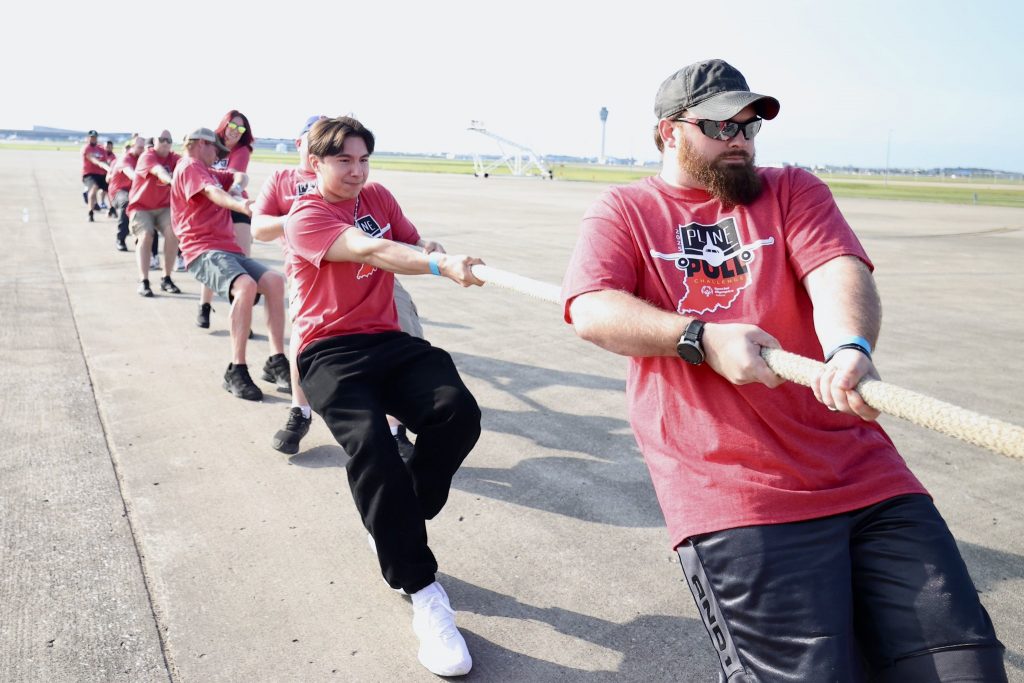
SOIN relies entirely on donations from individuals, corporations, and community partners to sustain its operations. Three of the biggest SOIN fundraisers have been the Save Arnold Games (held from 1981 to 2006), the Annual Polar Plunge (begun in 2000), and the Annual Plane Pull Challenge (launched in 2001). The first of these was hosted by Mari Hulman, chairperson of the Indianapolis Motor Speedway, as part of the Indianapolis 500’s opening weekend festivities. At the 1981 inaugural event, Hulman jokingly threatened to barbeque her pet pig, Arnold, unless a designated amount of money was raised for SOIN. Across the twenty-five years of the Save Arnold Games, Hulman raised close to $1.5 million for SOIN. By 2025, twenty statewide Polar Plunges, with Indianapolis events taking place at Eagle Creek Reservoir (see Eagle Creek Park), Geist Reservoir, and Butler University, had raised approximately $11.4 million. The Plane Pull Challenge occurs annually at the Indianapolis FedEx Express National Hub, with total contributions from 2001 to 2025 in the vicinity of $3.6 million.
Special Olympics Indiana Plane Pull team, 2025 Credit: Special Olympics Indiana View Source
Originally headquartered in Terre Haute, SOIN moved its administrative offices to Indianapolis in 1990. From this base, SOIN coordinates a network of area and county programs that empower participants to lead active and fulfilling lives in most parts of the state.
Across its existence, Special Olympics Indiana has made influential contributions to the social fabric of Indianapolis and the surrounding state. It remains a distinctive organization within Indiana due to its unique combination of sports training and competition with advocacy and community engagement.
Frollo, J. (2026). Special Olympics Indiana. Encyclopedia of Indianapolis. Retrieved Jul 20, 2026, from https://indyencyclopedia.org/special-olympics-indiana/.
Seymour Friedberg was the first director of the Indiana University School of Medicine’s Medical Educational Resources Program. He transformed medical education in Indiana by building a groundbreaking statewide television network that connected the Indiana University Medical Center with 17 teaching hospitals throughout the state.
A New York City native, Friedberg was born on August 16, 1920, to Emanuel Joseph Friedberg and Minnie Berkowitz Friedberg. Friedberg attended grade and high schools in New Jersey, then attended Rutgers and New York Universities before enlisting in the Army. During World War II, from 1943 to 1945, he was a clinical lab technician for the US Typhus Commission at Abbassia Fever Hospital in Cairo, Egypt. After the war, he returned to New York University, where he completed his bachelor’s degree in biology in 1948, followed by study at George Washington University, where he earned a master’s degree in zoology in 1952.
Friedberg continued his education doing medical research at Duke University (1952–1955) and completed a PhD in Audio-Visual Communications at the Audio-Visual Center at Indiana University-Bloomington (1956–1964). In 1965, he was acting chief of the Communications Section for the Center for the Study of Medical Education at the University of Illinois.
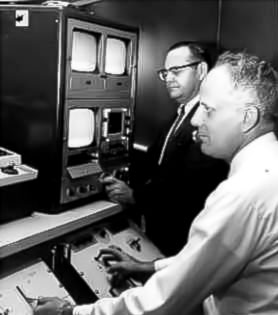
Seymour Friedberg and Ralph Nye adjusting electronic wave, ca. 1960s Credit: Indiana University Indianapolis View Source
Friedberg was appointed director and developer of the new educational resources program at the IU Medical Center in September 1966. The following year, the Indiana General Assembly enabled legislation to establish a telecommunications network that would decentralize medical education in Indiana, which was aimed at combatting the state’s shortage of physicians. One of Friedberg’s initial projects was the establishment of this television link between the medical center in Indianapolis and the university’s Bloomington campus—a component of the Indiana Plan’s envisioned statewide network, and one aimed at retaining IU School of Medicine graduates in the state. He set up the telecommunications system that transmitted information to practicing physicians throughout the state, as well as to interns and students enrolled in the statewide medical education program.
In 1968, a new project was initiated: the Medical Educational Resources Program (MERP). MERP provided television production of conferences, experiments, and lectures for medical students. Construction of a closed-circuit television network was started so that the medical students, interns, residents, and practicing physicians throughout the state could benefit from TV communications from the School of Medicine.
Friedberg developed a closed-circuit color medical television network, which served 17 teaching hospitals in Indiana. A medical videotape mailing network serving 34 Indiana hospitals also was established under Friedberg’s direction. In addition, he added a motion-picture facility and an instructional media section for medical educational materials. The facility provided materials to the IU School of Medicine for undergraduate education and to Indiana physicians for graduate and continuing education.
By 1969, the IU School of Medicine in Indianapolis credited the Indiana Plan, of which MERP was a part, with helping to eliminate the traditionally abrupt divisions between medical school, graduate medical education, and continuing medical education.
During his lifetime, Friedberg was vice president and a member of the board of trustees of Medical Television Broadcasters, past president of the Chicago and Central Indiana chapters of the Biological Photographic Association Inc., and a member of the University Film Association, the Audio-Visual Conference of Medical and Allied Sciences, and the Society of Motion Picture and Television Engineers. Locally, he served in many capacities, including being the institutional representative to EDUCOM (today known as EDUCAUSE) for Indiana University and IUPUI (now IU Indianapolis). Friedberg was a member of Sigma Xi, Phi Delta Kappa and Kappa Alpha Mu. He also worked in audiovisual sales and services.
On April 29, 1971, at age 50, Friedberg died suddenly at work in the Medical Science Building at the IU Medical Center.
FURTHER READING
The author adapted this EOI entry from their original article:
Bruner Stroup, K. (2026). Seymour Friedberg. Encyclopedia of Indianapolis. Retrieved Jul 20, 2026, from https://indyencyclopedia.org/seymour-friedberg/.
The Percussive Arts Society (PAS), headquartered in Indianapolis, is an international organization for percussionists and percussion educators, which maintains a significant presence in the local arts community. Established in 1961, the group moved to Indianapolis in 2007. PAS educates and supports percussionists in the areas of performance, pedagogy, and research. The organization hosts its annual Percussive Arts Society International Convention (PASIC) each November in Indianapolis, bringing percussionists and drummers throughout the world to the city.
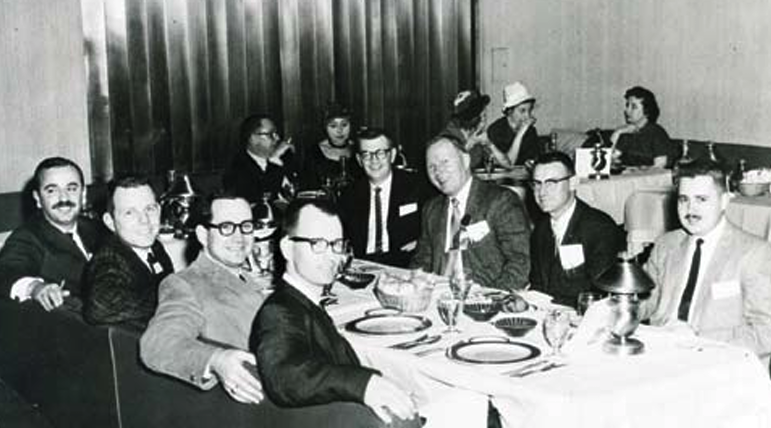
Several of the fourteen founding members of the Percussive Arts Society: (left to right, near side of table) Remo Belli, Jack McKenzie, Don Canedy, Mervin Britton, (left to right, far side of table) Hugh Soebbing, Vern Reamer and Sid Lutz, and Kenneth Leisen, ca. 1960s Credit: Percussive Arts Society
The organization’s origins came from discussions at the 1960 Midwest Band and Orchestra Clinic in Chicago, where a group of 14 percussionists and educators agreed that there was a need for standardization of solo and ensemble contests and improved percussion teaching methods. They envisioned creating a new organization to pursue those ends. In January 1961, during the Southwestern Division of the Music Educators National Conference in Albuquerque, New Mexico, a larger group of participants settled on a name: the Percussive Arts Society. By that fall, the first issue of a newsletter, the Percussive Arts Society Bulletin, had been published. By 1964, PAS had elected its first board of directors while garnering national influence as an authority on percussion education and professional standards.
In 1972, the society established the PAS Hall of Fame to commemorate the contributions of figures who have made “outstanding contributions to the world of percussion,” including musicians, educators, and others. To date, 158 figures, ranging from orchestral masters to jazz legends, have been inducted. PAS also began granting a Lifetime Achievement in Education award, in an effort to recognize the educational contributions of teachers and mentors who shape the next generation of musicians.
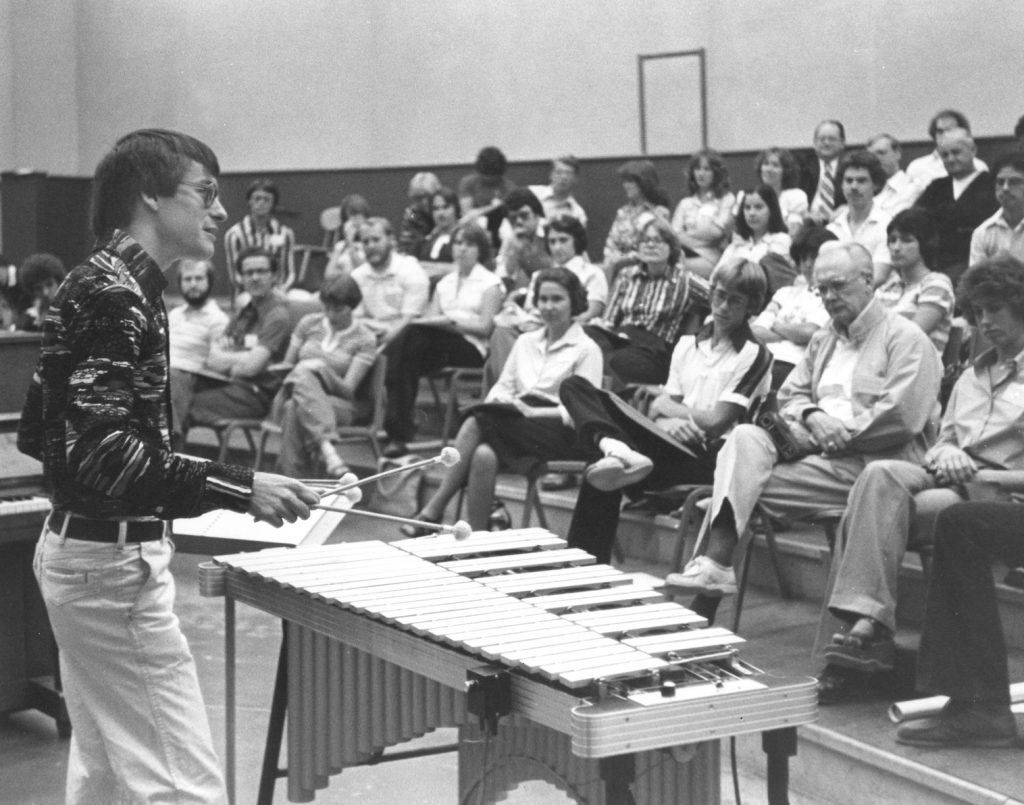
Bill Molenhof playing percussion instrument during the Percussive Arts Society International Convention (PASIC), 1978 Credit: Percussive Arts Society
The society has moved its headquarters several times during its lifetime. After being based in Terre Haute, Indiana, for 20 years, PAS moved to Urbana, Illinois, in 1981, where it hired its first professional staff. In 1992, the organization relocated to a custom-built headquarters and museum in Lawton, Oklahoma, to house its growing collection.
In 2005, the board of directors voted to relocate the organization to Indianapolis. This move sought to unite the PAS headquarters, its archival library, and the annual convention in a single city after decades where the convention took place in a city other than the headquarters and library home. The administrative offices moved to Indianapolis in 2007 and, in 2009, PAS opened its archival library and museum, named the Rhythm! Discovery Center, in downtown Indianapolis’s Claypool Court building (see Claypool Hotel). The interactive percussion museum showcases an extensive collection of rare instruments, archives, scores, and recordings, and provides educational programming, for visitors from Indiana and elsewhere.
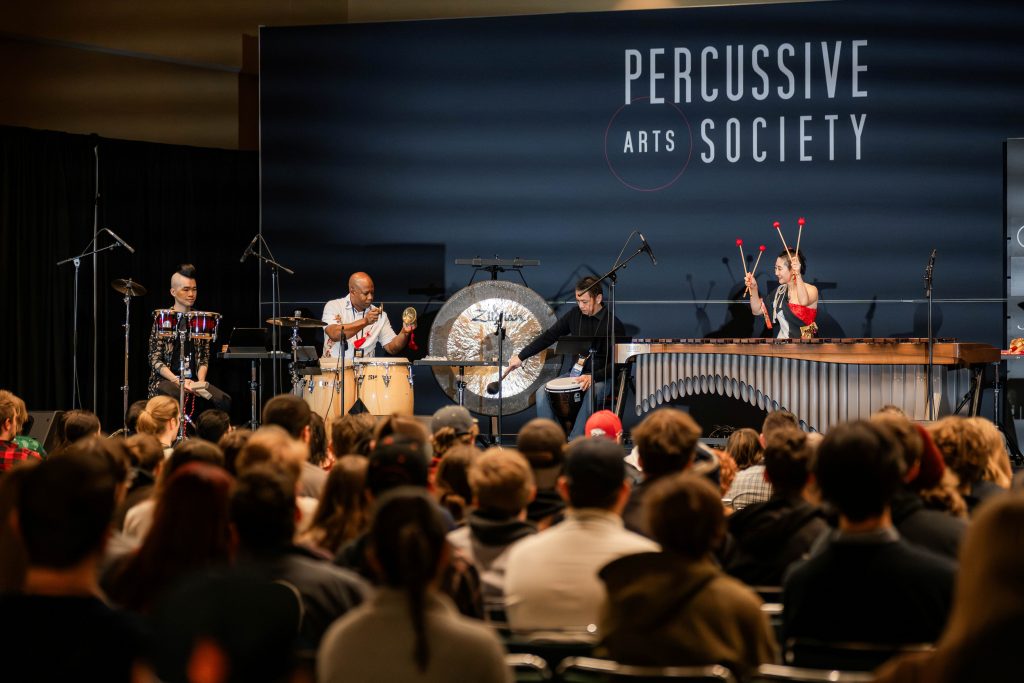
A session at the Percussive Arts Society International Convention (PASIC) featuring Kana Omori, who is joined by (from left) Matthew Lau, Damon Grant, and Satur Tiamson, 2025 Credit: Percussive Arts Society
The organization’s membership eventually expanded across the continent and internationally. By 2026, PAS had 6,000 members across 48 US chapters and 20 international chapters, and offered benefits such as access to a digital research database, the Percussive Notes journal, and DRUMSET magazine. Specialized committees covering a range of topics—from drum set and marching percussion to diversity and healthcare—are sponsored by the organization. The organization’s main annual event, the PASIC, began in 1976 and features concerts, clinics, and panels that span a diversity of musical genres. It has been held in Indianapolis each year since 2016. The 50th PASIC convention, held in 2025, drew a record attendance of 7,837 participants.
Simonds, J. (2026). Percussive Arts Society. Encyclopedia of Indianapolis. Retrieved Jul 20, 2026, from https://indyencyclopedia.org/percussive-arts-society/.
MLA:
Simonds, Joshua. “Percussive Arts Society.” Encyclopedia of Indianapolis, 2026, https://indyencyclopedia.org/percussive-arts-society/. Accessed 20 Jul 2026.
Chicago:
Simonds, Joshua. “Percussive Arts Society.” Encyclopedia of Indianapolis, 2026. Accessed Jul 20, 2026. https://indyencyclopedia.org/percussive-arts-society/.